Side-by-side vehicle (SBV) manufacturers are offering models that are increasingly more powerful, better equipped, larger, and heavier. However, they run up against the regulatory limitations in Quebec that everyone is familiar with: a maximum of 950 kg (it is not yet clear whether this refers to dry, wet, or gross vehicle weight), a maximum width of 66 inches, and a maximum engine displacement of 1,000 cm³. These limitations apply only on federal trails. No restrictions are imposed on public lands or controlled operating zones (ZECs), for example.
Social media is full of opinions and disagreements among ATV riders on this subject. While clubs want to limit the weight and dimensions of these vehicles because the trail network’s capacity is struggling to keep up, users are criticizing these restrictions. Indeed, many would like to be able to purchase large machines like the Polaris Ranger 1500 HD or a Yamaha Wolverine RMAX4 to ride on federated trails, but they run into regulatory limits. “It’s only in Quebec that we’re regulated like this!” they complain. Really? Only in Quebec? Taking a quick look at the other jurisdictions around us reveals some surprising findings.
New Brunswick, Nova Scotia, Prince Edward Island
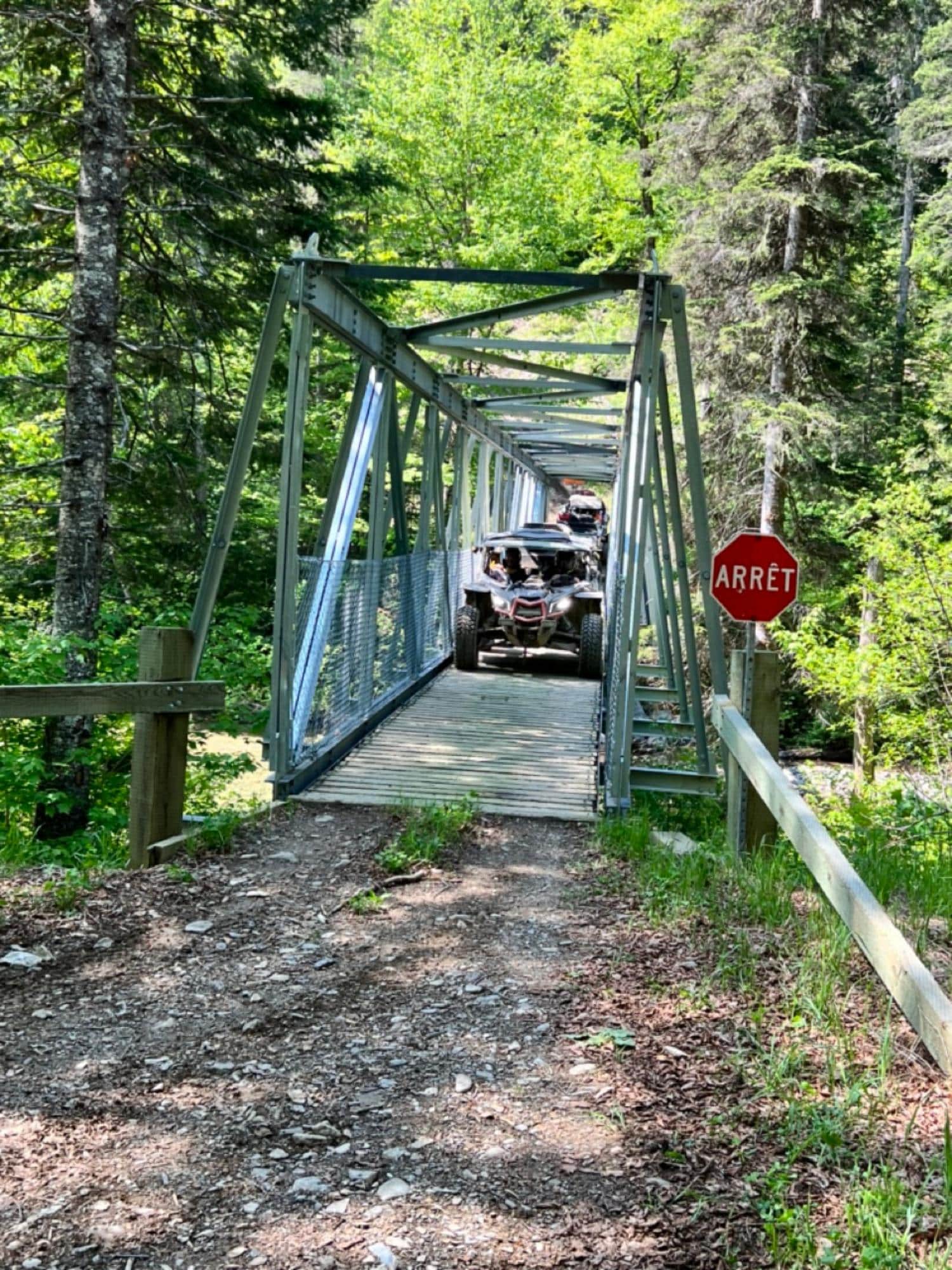
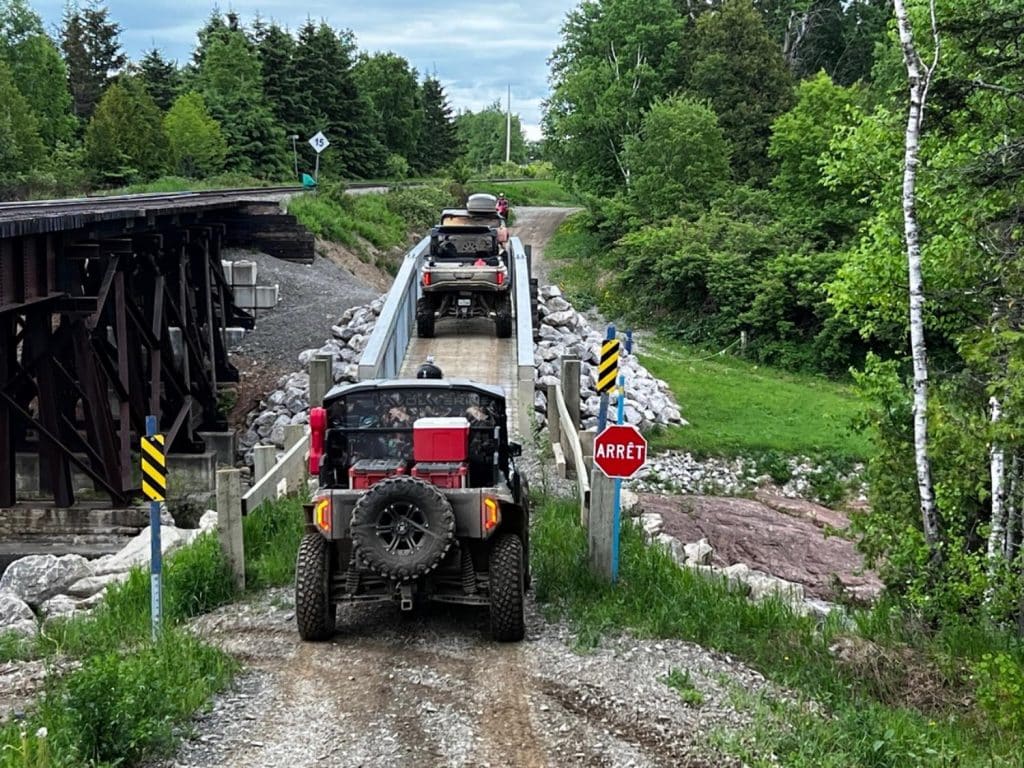
The law does not directly restrict weight and dimensions in the legislative text. But in the Maritimes, clubs don’t just use wide forest roads; they also use old, narrow ATV trails, railway bridges, and other infrastructure that limits width.
Only New Brunswick limits the net weight of ATVs… to 1,200 kg. No jurisdiction limits width, but the QuadNB federation recommends maintaining trails at a width of 68 inches; however, in practice, clubs in all provinces often place blocks or barriers to limit the width to 66 inches. Thus, 66 inches becomes the practical standard even when it is not directly specified in the law.
Ontario
In Ontario, the situation is more complex because there are provincial laws as well as regulations from various federations.
Provincial Law (Public Roads) (Highway Traffic Act – O. Reg. 316/03)
To drive on certain authorized roads where SxS vehicles are expressly permitted, the maximum width is 2.03 m and the maximum net weight for off-road recreational vehicles is 1,700 kg. The maximum engine displacement is 1,000 cm³.
OFATV Network (Ontario Federation of All-Terrain Vehicle Clubs):
- Maximum width: 65 inches for all of its trails. Many local clubs even limit access to 50 inches in certain narrow areas.
- Weight: must comply with the manufacturer’s specifications and maximum load ratings.
EOTA (Eastern Ontario Trails Alliance):
- Maximum width and weight: unlike the OFATV, the EOTA has no official size restrictions listed in its regulations for its main trails.
- Physical constraints: certain bridges or narrow passages physically prevent 72-inch vehicles from passing, even though they are legally permitted there.
KATVA (Kawartha ATV Association) trails:
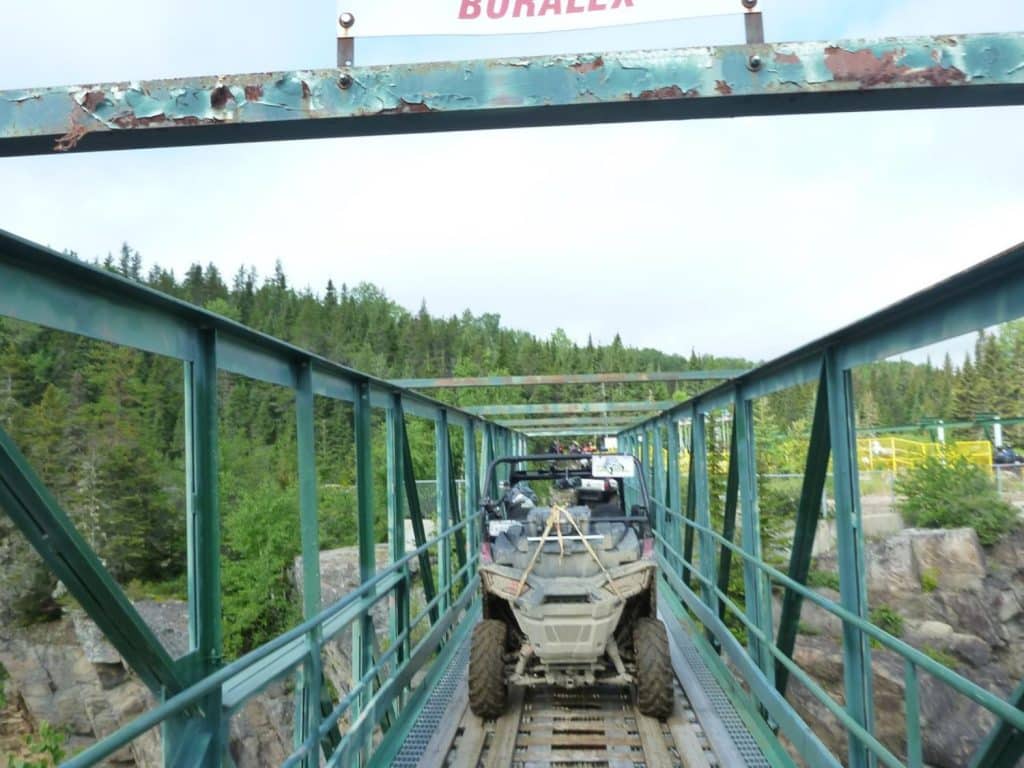
The standard limit is generally set at 64 inches to ensure passage on local infrastructure.
British Columbia:
In British Columbia, weight and dimension restrictions for off-road vehicles are defined by the Off-Road Vehicle Act. The law is less restrictive regarding overall dimensions, but local trail management imposes stricter physical limits.
Provincial Law (Off-Road Vehicle Regulation)
The regulation defines the classes of off-road vehicles (ORVs) authorized on Crown land.
- Gross weight: An ATV is classified as an ORV as long as its gross vehicle weight rating (GVWR) is less than 4,536 kg (10,000 lbs).
- Maximum dimensions: Provincial law does not specify a single width limit for general off-road use.
Local trail management restrictions
This is where the restrictions become the strictest. Many trail networks in BC are classified by trail type:Single-track trails: reserved for off-road motorcycles.
- Double-track trails: generally limited to a maximum width of 50 inches. For example, the Bear Creek trail network strictly prohibits UTVs wider than 50 inches on its marked trails.
- Multi-use trails: on some larger networks, 64-inch vehicles are permitted, but 72-inch “Wide” models are often physically unable to navigate due to dense forest or narrow bridges.
United States
Regulations across different areas in the United States form a patchwork that would take too long to list in detail. Let’s look at those in neighboring states where you might have the opportunity to ride.
Maine
In Maine, the law defines a specific category called “Oversized ATV” that drastically limits access to trails. Although there are plans to increase the weight limits, the following limits apply as of 2026:
- Maximum width: 65 inches
- Maximum weight: 2,000 lbs (907 kg).
Vehicles exceeding these limits cannot be registered in Maine and are therefore prohibited on the public trail network and trails maintained by clubs. There is a grandfather clause for Maine residents who have an ATV registered before January 1, 2022.
Note that no exceptions are granted to non-residents. A tourist cannot operate an oversized vehicle on the trails, even if they have a valid registration from their own province or state.
Vermont
In Vermont, restrictions on side-by-side vehicles are governed by state registration laws and by the rules of the VASA(Vermont ATV Sportsman’s Association) regarding trail access.
To be classified and registered as an off-road vehicle with the Vermont DMV, the vehicle must meet the following criteria:
- Maximum width: 72 inches.
- Net weight: less than 2,500 lbs (1,134 kg)
Although the state allows registration for vehicles up to 72 inches wide, the VASA, which manages the vast majority of trails on private land, imposes a more restrictive limit to protect infrastructure:
- Maximum width: 64 inches
- Maximum weight: despite the law allowing up to 2,500 lbs (1,135 kg), some local club regulations or municipal ordinances may still refer to older limits of 1,700 lbs (771 kg).
New Hampshire
In New Hampshire, weight and size limits for off-road recreational vehicles (OHRVs/UTVs) are distinguished by a very clear geographical divide between the northern and southern parts of the state.
·Width limits (depending on whether in the northern or southern part of the state)
Regulations from the New Hampshire Fish and Game Department enforce strict restrictions depending on the county where you are riding.·
Weight limit:
- Southern New Hampshire: All OHRVs wider than 50 inches are strictly prohibited on state-owned trails. This area is reserved for traditional ATVs and small UTVs.
- Northern New Hampshire (Coos and Grafton counties): VCCs with a maximum width of 65 inches are permitted on state-approved trails. This includes popular trail systems such as Jericho Mountain State Park.
New Hampshire recently reformed its weight laws through House Bill 174, which took effect to modernize standards in response to increasingly heavy modern vehicles. The maximum net weight allowed for a vehicle to be classified as a side-by-side is now set at 1,587 kg (previously 907 kg).
Restricted trails: Please note that on trails limited to 50 inches in width in the southern part of the state, the net weight limit remains at 454 kg.
New York State
In New York State, regulations regarding the net weight and dimensions of side-by-side vehicles are also governed by two levels of legislation: state-wide legislation and local club regulations.
State Law (New York Vehicle and Traffic Law)
New York State applies specific criteria for an off-road vehicle to be legally registered as an ATV/UTV with the New York DMV,2. Club and Trail Network Restrictions (Physical Limits)
- Maximum Weight (Curb Weight): 907 kg
- Maximum width: the maximum legal limit is set at 80 inches.
Despite state legislation, the configuration of the state’s public and private trail network greatly restricts wide vehicles. Local club standards: The vast majority of clubs (such as the Oswego Valley ATV Club) enforce a strict local width limit of 65 inches.
Elsewhere in the United States
- Alaska: On state lands, use is generally permitted for ATVs/SxS vehicles with a curb weight of 680 kg or less. Some BLM areas restrict width to 50 inches.
- Florida: 55-inch width limit and 680 kg weight limit on many trails.
- Utah, Arkansas (Ouachita): Very popular trails (such as Wolf Pen Gap) limit width to 64 inches, preventing access for 72-inch vehicles.
- National Forests/BLM: The standard limit for narrow trails is 50 inches, although some roadways allow wider vehicles.
Let’s compare Quebec’s regulatory situation with that of its neighbors…
With few exceptions, all authorities regulate the weights and dimensions of ATVs, whether they are provinces/states or local trail operators. And many are stricter than here in Quebec. In Quebec, the limits apply only to federal trails, and for the rest of the territory, no limits are in effect. States like Maine are stricter, and regulations apply throughout the entire state.
The 64-inch width seems to be the consensus almost everywhere, even though some older trail networks are limited to 50 inches here and there. As for the maximum allowable weight, many jurisdictions have a net weight similar to that allowed here (907 kg or 2,000 lb), but we see that several have increased the allowable weight for ATVs to keep pace with the market as dictated by manufacturers. We know that the FQCQ has asked the Quebec government to reassess this figure, but we are awaiting the ministry’s response.
Ultimately, when we compare ourselves to others, we take comfort in the fact that, contrary to certain perceptions expressed on social media, Quebec’s current legislation remains relatively permissive.