If you think a bottle of motorcycle engine oil is just a can of sticky liquid with a number written on it, it’s probably time we had a little chat. So here’s everything your bottle is trying to tell you (and that you’re probably unaware of).
The Role of Engine Oil
A bottle of motorcycle oil isn’t just a maintenance product. It’s a mechanical contract. A long-term insurance policy. A silent agreement between your engine… and your wallet.
And this contract is particularly important if you ride a touring motorcycle or an adventure motorcycle (ADV).
Because even though these machines may sometimes ride on the same roads, their mechanical lives are anything but a leisurely stroll.
Your street bike might spend hours at high speed on the highway.
Your adventure bike might spend a full hour climbing gravel hills in first gear, loaded with luggage, in 30°C heat. (And sometimes even on its side, idling.)
In both cases, there’s one constant.
Your oil is working
It heats up.
It absorbs.
It protects.
It cleans.
It lubricates.
And while you’re admiring the scenery, taking a photo, or trying to explain to your friends why you need another set of tires this season, the oil keeps doing its job without complaint.

So today, you’re going to break down what every detail on a bottle of motorcycle engine oil actually means.
No chemistry degree required.
No unnecessary jargon.
But with enough technical detail so you understand what you’re putting in your engine and look like a pro when you bring the bottles to the parts counter.
Sit back and relax.
We’re diving into the mysterious—and slightly underrated—world of motorcycle engine oil.
10W-40: The secret code you think you already understand
The first thing you see on an oil bottle is almost always something like:
10W-40
5W-40
15W-50
20W-50
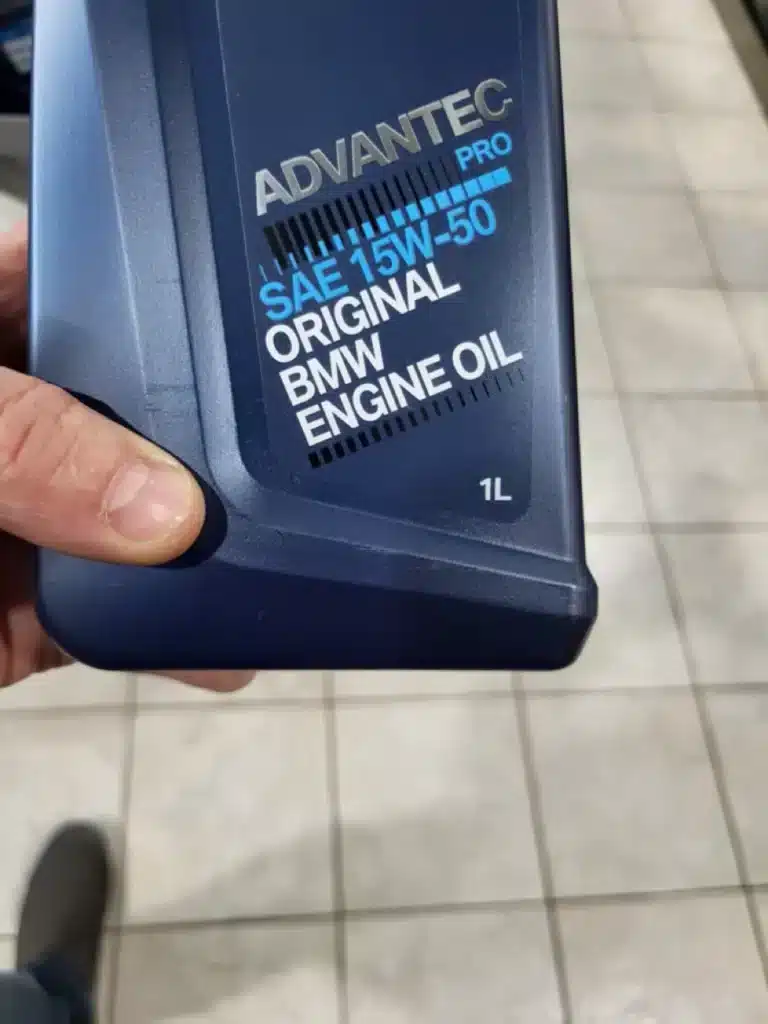
This is what’s called SAE viscosity. SAE stands for Society of Automotive Engineers.
Yes, it starts off serious. But don’t be intimidated: it’s less complicated than an electronic fuel injection manual.
The “W” stands for Winter, not “Wow”
The number before the W indicates the oil’s flowability when cold.
The lower this number is:
- the easier your oil flows when starting the engine
- the faster lubrication occurs
- the less your engine wears out in the first few seconds
And that’s where it gets interesting, because an engine wears out significantly during startup.
Metal surfaces have only a thin film of oil; pressure isn’t distributed evenly, and for a few seconds, the parts are operating almost dry. If you drive in Quebec in the spring or fall, at temperatures of 3 or 4 °C in the morning, this detail becomes important.
For example:
- a 5W-40 oil will circulate more quickly when cold.
- a 10W-40 oil will be slightly thicker at startup
- with a 20W-50 oil, say your prayers because it’s closer to maple syrup.
If you start your motorcycle early in the season, that first number can make a real difference.
The “40”: when your engine starts working
The second number represents the viscosity at operating temperature, generally around 100 °C.
And believe it or not, your engine reaches this temperature easily. VERY easily.
For example:
- in heavy city traffic
- on winding roads at high speeds
- on slow-moving trails
- in the summer heat
- when carrying luggage and a passenger
A loaded adventure bike works very hard. But even your touring bike can generate a lot of heat when riding at high speeds for long periods.
Choosing the right viscosity is therefore not a marketing detail; it’s a mechanical engineering choice. For a very hot engine with oil that’s too thin, it’s a bit like running a marathon in flip-flops.
It’s technically doable, but you probably won’t like how the story ends.
Mineral, semi-synthetic, or 100% synthetic oil?
Welcome to the eternal debate among riders gathered around the campfire come evening.
It often starts with: “My cousin’s been using that for twenty years, and he’s never had a problem.”
Your cousin might be lucky. But let’s stay serious for a bit longer.
Mineral Oil
Mineral oil comes directly from petroleum refining.
Its characteristics are:
- adequate protection
- low cost
- faster degradation
- and lower heat resistance
If you ride an old, simple, low-maintenance motorcycle, it might work.
But if your machine is modern, with fuel injection, high compression, and tight tolerances, it’s not the ideal choice.
Semi-synthetic oil
Semi-synthetic oil is a blend of mineral oil and synthetic base stock.
Its advantages are:
- better protection
- improved thermal stability
- reasonable cost
For mixed use on roads and light trails, it’s often a good compromise. As long as you follow a slightly shorter maintenance schedule.
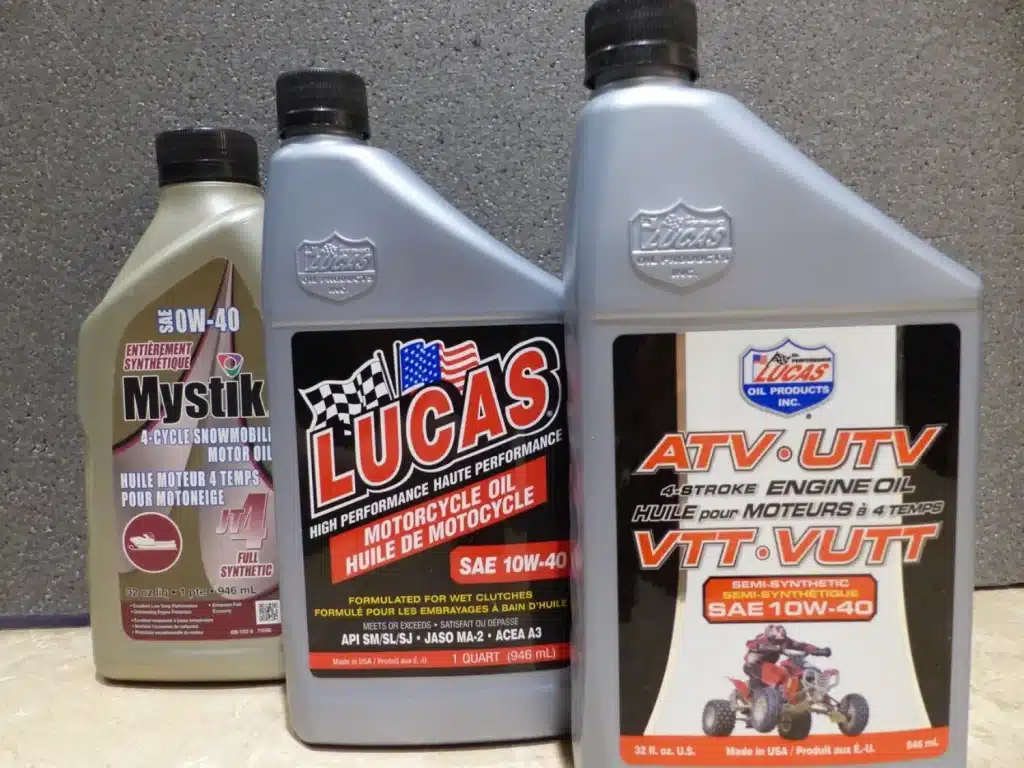
100% Synthetic Oil
For most modern motorcycles, this is often the best choice.
Why?
Because synthetic oil offers:
- excellent thermal stability
- superior shear resistance
- longer service life
- maximum engine protection
If you spend a lot of time on the highway or go on adventures far from home, synthetic oil becomes an excellent investment when you want your oil to do its job right.
Synthetic oil is a bit like a good GPS: you hope you’ll never absolutely need it, but when things get complicated, you’re very glad you have it.
JASO MA2: The Information You Should Never Ignore
Here is probably the most important detail about motorcycle oil.
The standard: JASO MA or JASO MA2
JASO stands for Japanese Automotive Standards Organization.
This standard exists because motorcycles have a different mechanical configuration than cars.
In many motorcycles, a single oil lubricates three components:
- your engine
- your transmission
- your wet clutch
Yes. Everyone shares the same pool.

The wet clutch and its delicate balance
Your clutch works thanks to controlled friction between the plates.
If your oil contains additives designed to reduce friction—like some automotive oils—the clutch can become too slippery and stop working properly.
The result: you’ll experience slippage, a loss of power, and premature clutch wear.
The JASO MA or MA2 standard ensures that the oil has the appropriate friction properties for a modern wet clutch.
So if you take away just one thing from this article: always choose a JASO MA or MA2 certified oil for your motorcycle.
It’s literally the difference between a happy clutch and a clutch that starts slipping at the worst possible moment.
API SN, SP: useful… but secondary
You’ll also sometimes see these letters on oil bottles:
API SN
API SP
API stands for American Petroleum Institute.
These standards indicate that the oil meets certain criteria, such as:
- wear protection
- chemical stability
- deposit control
- oxidation resistance
That’s a good thing. But for your motorcycle? It’s less critical than the JASO standard. However, consult your owner’s manual, as certain additives play a crucial role specific to your motorcycle. Especially the anti-noise additives that engineers request be added by the oil company that manufactures the original equipment oils.
In summary:
API = general quality
JASO = motorcycle compatibility
Shear resistance: the invisible stress
In a car, oil lubricates the engine. In your motorcycle, it must also withstand the torture of the gearbox. And the gears in a gearbox aren’t exactly known for their delicacy.
They exert enormous pressure on the oil film. This phenomenon is called shear. Over time, some oils lose their actual viscosity under these stresses.
An oil that was technically a 10W-40 can gradually behave like a 10W-30. In extreme cases, this can cause false neutrals and even make shifting gears nearly impossible on the first try.
Synthetic oils resist this phenomenon much better.
And if you’re driving with a heavy load for extended periods in the heat, both on and off-road, this shear resistance becomes very important.
HTHS, TBN, and Other Mysterious Acronyms
For those who love technical details, there are other parameters.
- HTHS: HTHS stands for High Temperature High Shear. It measures the oil film’s resistance at high temperatures and under high mechanical stress. The higher this value, the more stable your oil film remains.
- TBN: Total Base Number measures the oil’s ability to neutralize acids produced by combustion. The higher the TBN, the longer your oil can last before becoming chemically aggressive. This data isn’t always visible on the bottle. But it’s used in laboratories to assess an oil’s true quality.
Yes. Your oil literally does the work of a chemist while you ride.
“Energy Conserving”: The Classic Trap
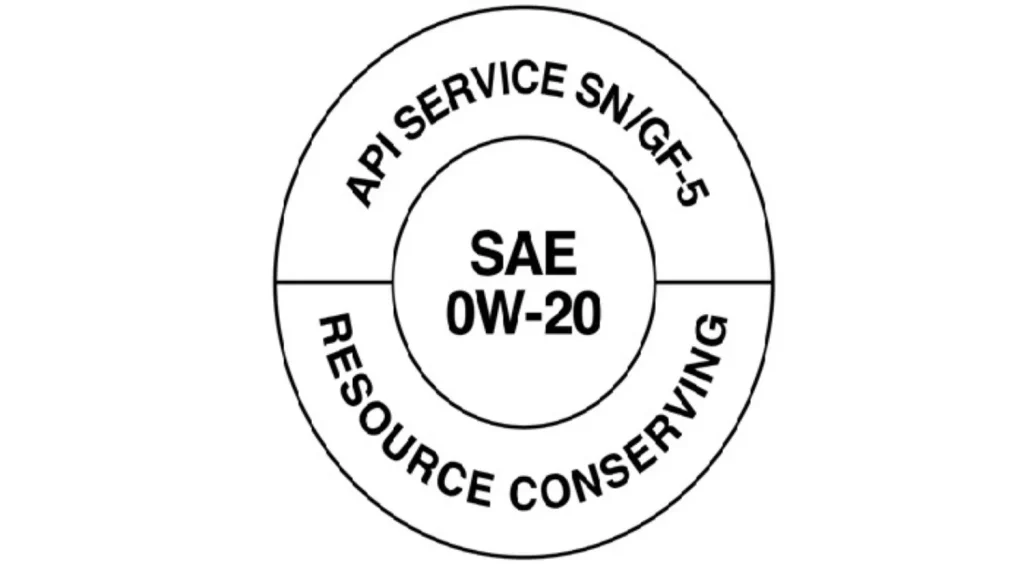
If you see this label on a bottle: “Energy Conserving,” avoid it for your motorcycle.
These oils are designed for cars to reduce fuel consumption using friction modifiers. That’s great for a family sedan, but what about your wet clutch?
It’s a recipe for slippage and loss of clutch traction.
In short, it’s not a good idea.
Oil Change Interval: The Never-Ending Debate
You’ll sometimes hear: “Synthetic oil can easily last 10,000 km.”
Technically, that’s not entirely wrong. But in real life, your motorcycle may be subjected to intense heat, dust exposure, long highway trips or city traffic, prolonged low-RPM operation, and vibrations.
All of this accelerates oil degradation.
And you have to remember one simple thing: an oil change costs about a hundred dollars. A rebuilt engine can cost several thousand. The math doesn’t lie.
Why Oil Is Critical for Your Motorcycle
We often talk about extreme conditions for adventure bikes. But even your street bike can face demanding mechanical conditions.
A street bike can spend hours:
- at high speeds
- under heavy loads
- carrying luggage with a passenger
- in intense desert summer heat
An adventure bike can:
- carry 30 to 40 kg of luggage
- ride slowly on technical terrain
- endure significant vibrations
In all these situations, oil is the only barrier between metal and metal. It’s a microscopic film that prevents very expensive parts from turning into a metal soup.
Without this protection? Your engine can quickly become a very expensive project.
A Quick Practical Summary
When choosing oil for your motorcycle:
- check the recommended viscosity
- opt for a high-quality synthetic oil
- ensure it meets the JASO MA2 standard
- avoid Energy Conserving oils
- follow the manufacturer’s manual
- adjust the oil change interval to your actual usage
Simple.
Effective.
And very good for your engine’s health.

Conclusion: Oil doesn’t make a sound… but it saves your engine
Engine oil isn’t very glamorous.
It doesn’t make a sound.
It doesn’t have LED lights.
It doesn’t boost your power.
No one turns around in a parking lot to admire your oil bottle.
But it protects your engine when you’re far from home, loaded down, tired, and sometimes a little lost on a forest road.
And in the world of motorcycling—whether on the road or off-road—reliability is often sexier than performance. So the next time you hold a bottle of motorcycle oil in your hands…
Take a few seconds to read the label with a serious and confident air, now that you understand what it’s telling you. Because good engine oil does more than just lubricate. It gets you home.
And while we’re on the subject of oil…
Have you thought about your oil filter? Because it has a say in the matter, too. But that… is another story.