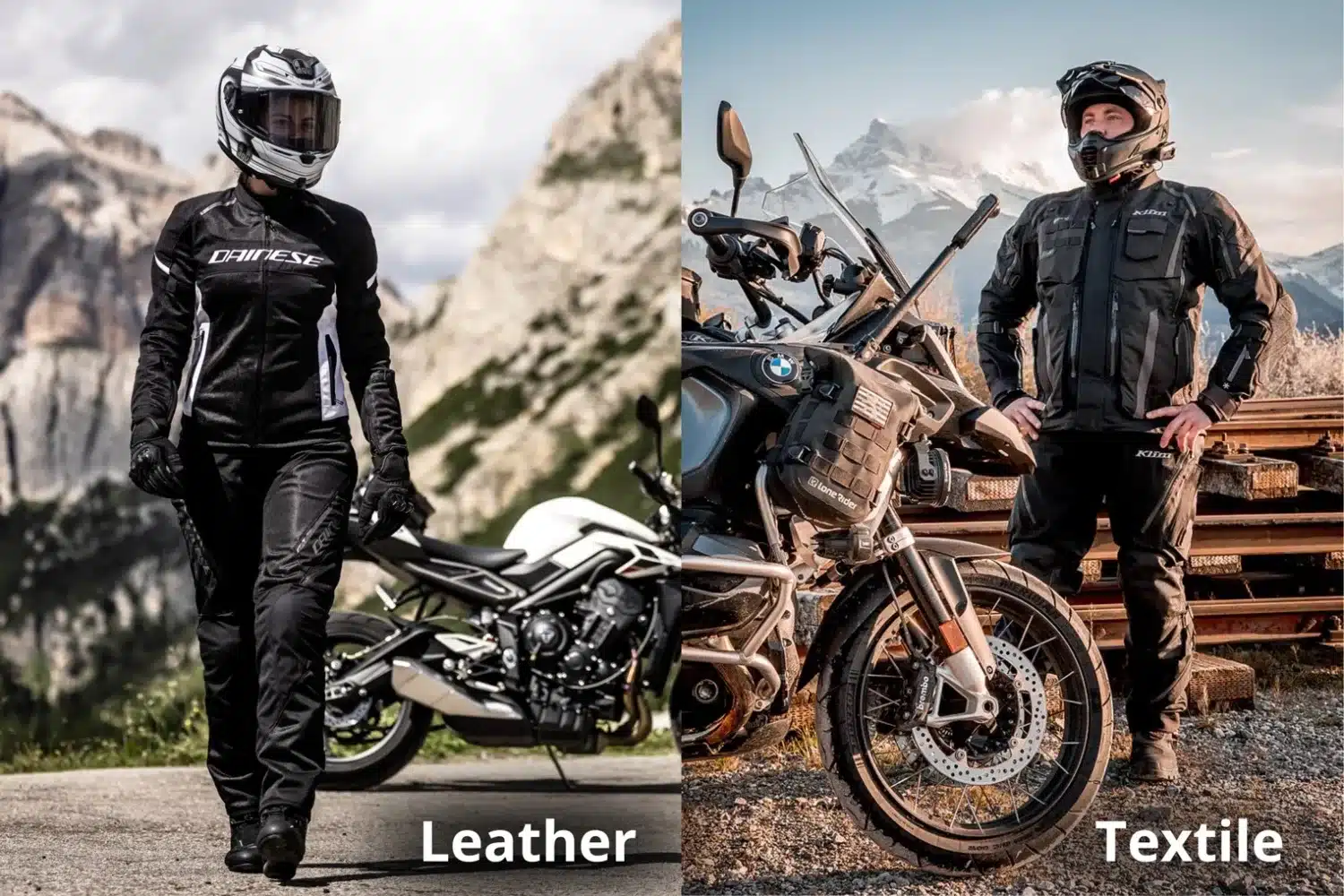
Aside from the die-hard rebels who ride in T-shirts and flip-flops, leather is the standard choice for motorcycle protective gear. A noble material derived from cows or kangaroos that took off thanks to Marlon Brando and his leather jacket in the 1953 film “The Wild One.” But synthetic fibers are making inroads and competing with good old leather.
The “neo-motorcyclist” is looking for versatility. They want to be able to ride through a downpour without carrying an extra ten pounds and cruise in 30°C heat without risking heatstroke. The “adventure” community now has its own uniform—often gray—made entirely of waterproof and breathable synthetic fibers. The trend is toward protective clothing, but without the custom biker’s “patches.” This is where chemistry and textile technology come into play. Today, clothing labels are full of technical and scientific names like Gore-Tex, Kevlar, Dyneema, Armalith, D3O, Sympatex, and Primaloft. Standards exist to measure shock absorption and abrasion resistance, using ratings from A to AAA based on the gear’s durability and impact resistance. How can you make sense of all these options, each with its own uses and benefits? That’s the goal of this article!
Abrasion Resistance
In the event of a fall, the garment must resist mechanical fiber breakage and the heat generated by friction that can burn the skin. Here are the best materials when it comes to “friction science”!
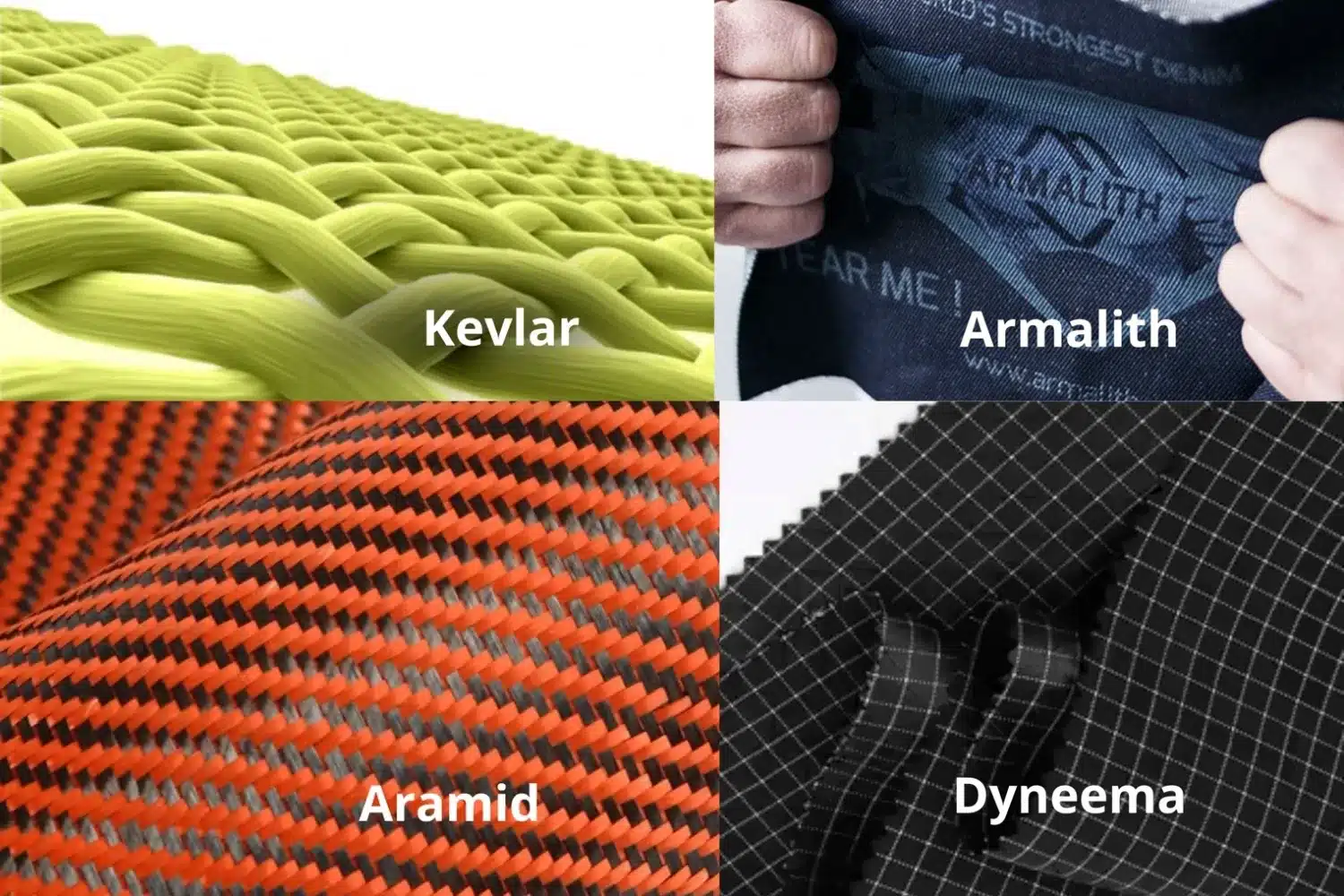
Kevlar (Aramid) was the first material of its kind on the market. It is an extremely strong material that provides ballistic resistance, originally used in bulletproof vests. Kevlar fibers are woven so tightly that they cannot be separated. When used in pants or a jacket, the fibers resist the heat generated by friction.
Armalith is a newer material. It resembles cotton and allows for the creation of comfortable jeans using a single layer of fabric. The cotton fiber is combined with a fiber reinforced with “ UHMWPE.” In the event of a fall, it protects against abrasion and can withstand a slide of over 30 meters, earning it an AAA rating.
Dyneema is defined as the strongest fiber in the world; it is 15 times stronger than steel for the same weight. Also derived from UHMWPE, it offers exceptional resistance to cuts and abrasion. Its melting point is lower than Kevlar’s, but it dissipates heat better, earning it an AAA rating.
Waterproof and Breathable
Like cork stoppers or duck feathers, these new materials are waterproof on the outside and breathable on the inside. They block moisture and rain while allowing sweat to escape.
Gore-Tex is the gold standard; it uses an ePTFE membrane available in three variants:
- Gore-Tex Pro is laminated directly to the outer fabric (such as Cordura). Lightweight and water-repellent, it prevents the garment from becoming waterlogged and dries instantly, justifying its price tag with formidable effectiveness in torrential rain.
- Gore-Tex Z-Liner is more common and the most flexible. It is loosely inserted into the lining. The outer fabric can become saturated during prolonged downpours, slowing the drying process.
- Finally, Gore-Tex Grip enhances gloves: the layers are fused together. This fusion eliminates friction between the layers and increases waterproofing. The lining does not separate from the glove when it is removed.
Sympatex differs from traditional membranes in its physical and chemical functioning. Like a filter, it draws in and wicks away sweat. Unlike the fixed pores of Gore-Tex, its structure expands when heat or humidity increases. Unlike Gore-Tex, it is fully recyclable.
For insulation, Primaloft has dethroned natural feathers and cotton. This ultra-fine microfiber mimics the structure of feathers while offering record-breaking lightness and compressibility. Incredibly, it retains its thermal properties even when wet. The experience is striking in a glove: the sensation of warmth and softness is immediate, even when wet.
Finally, 37.5 technology is revolutionizing thermoregulation thanks to volcanic rock particles integrated into the core of the fibers. This system utilizes the body’s infrared energy. When it’s hot, it accelerates the evaporation of water vapor before it even condenses; when it’s cold, it traps this energy to warm the body.
Absorbing shocks
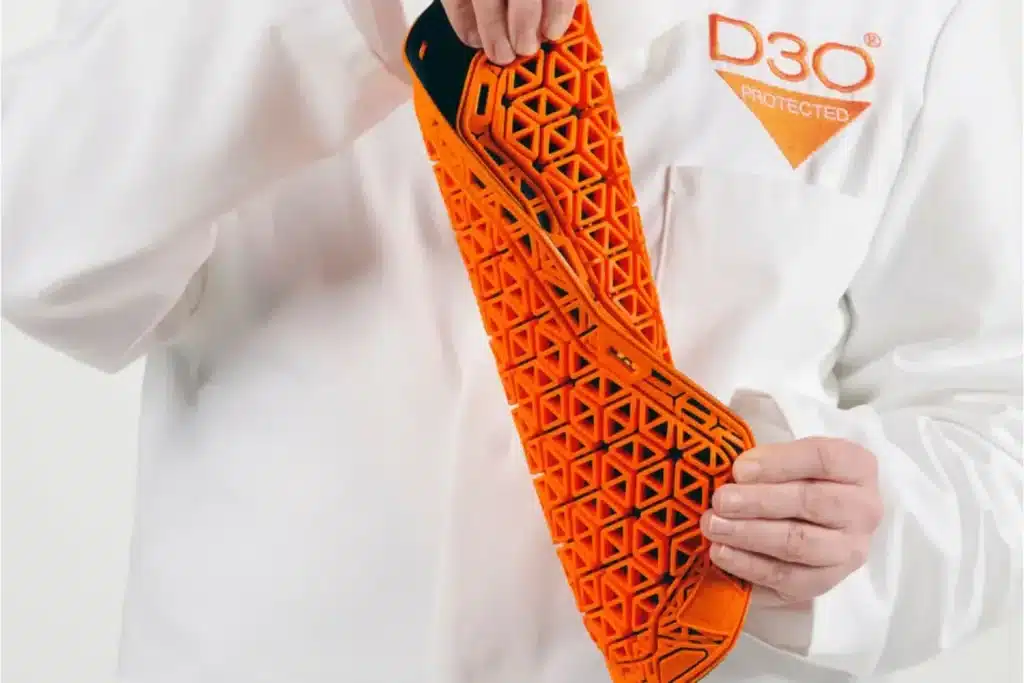
D3O, recognizable by its orange color, is a smart material composed of non-Newtonian molecules. Soft at rest for comfort, it instantly locks up upon impact to absorb and dissipate energy, before returning to its flexible state.
Used for back protectors and joints, it is a superior replacement for older rigid shells. Impact Print technology sculpts ventilated geometric shapes to reduce weight while increasing flexibility. Its certification drops from Level 3 to Level 2 in this configuration.
Trusting Your Gear
A garment may look like a motorcycle model, with reinforcements at the elbows and shoulders and a slim fit. And yet, it may just be a knockoff that will tear as soon as it hits the ground, because the stitching isn’t strong, with a lining that will cause burns during a slide, and whose hard protectors will increase bodily injury. The best way to avoid this mishap is to choose clothing that meets European standards, which can be identified by the EN 17092 standard label and a rating ranging from A to AAA.
This standard evaluates abrasion resistance and impact absorption.

The A-class model is ideal for urban commuting and leisurely rides; the PPE (Personal Protective Equipment) is lightweight, breathable, and flexible. The protective shells are lightweight for greater ease and comfort. The abrasion test speed is 45 km/h.
The AA class meets the standard for commuters and daily riders in Quebec. If you ride at highway speeds, the AA level will do the trick. It’s more comfortable and not too heavy. It offers solid protection with comfort in mind, featuring abrasion tests at 70 km/h.
The AAA class is the highest level of protection, designed for racing. Abrasion tests are conducted at a speed of 120 km/h. We’ve seen crashes at 300 km/h in MotoGP with minimal damage. Impact zones are protected. Naturally, the armor is a bit heavier.
Leather is Still Going Strong
Leather is still a good option for protection. It’s a natural product that resists abrasion in the event of a crash. In fact, it’s used for suits in road racing, all the way up to MotoGP and the World Superbike Championship. It can absorb impacts if equipped with the right protective shells and back protectors. Leather is breathable and can be treated with a waterproofing product, such as wax, after applying a layer of nourishing cream to prevent drying out. However, it is heavy, and its water resistance is limited nonetheless. In heavy rain, the water will wash away the wax layer and seep inside. In intense heat, there’s nothing you can do about sweat, and it will remain trapped in the synthetic lining—unless you opt for a blend of leather and Gore-Tex or Primaloft. But leather looks so good! It feels pleasant to the touch. It conveys a strong image. If you want to be part of the community, leather is your look. Choose it with the EN 17092 standard and an AA or AAA label.
Conclusion
Leather remains a historical benchmark for its durability, but textiles reinforced with materials like Kevlar or Dyneema now offer high-level protection with unmatched comfort. Whether you prioritize tradition, lightweight design, or active thermoregulation, safety is no longer a compromise. With this information on certifications and materials, you now have everything you need to choose the gear that’s perfectly suited to your riding style.