A motorcycle’s braking system is the most important component in terms of safety. It’s not just about slowing down, but about controlling the motorcycle in emergency situations, often in a matter of fractions of a second. Whether it’s pure performance or everyday safety, an effective braking system is essential for riding with peace of mind and avoiding the unexpected. Checking and maintaining your brakes should not be neglected. Replacing brake pads, checking the level and bleeding the brake fluid, cleaning the calipers, and inspecting the hoses are all part of the checklist.
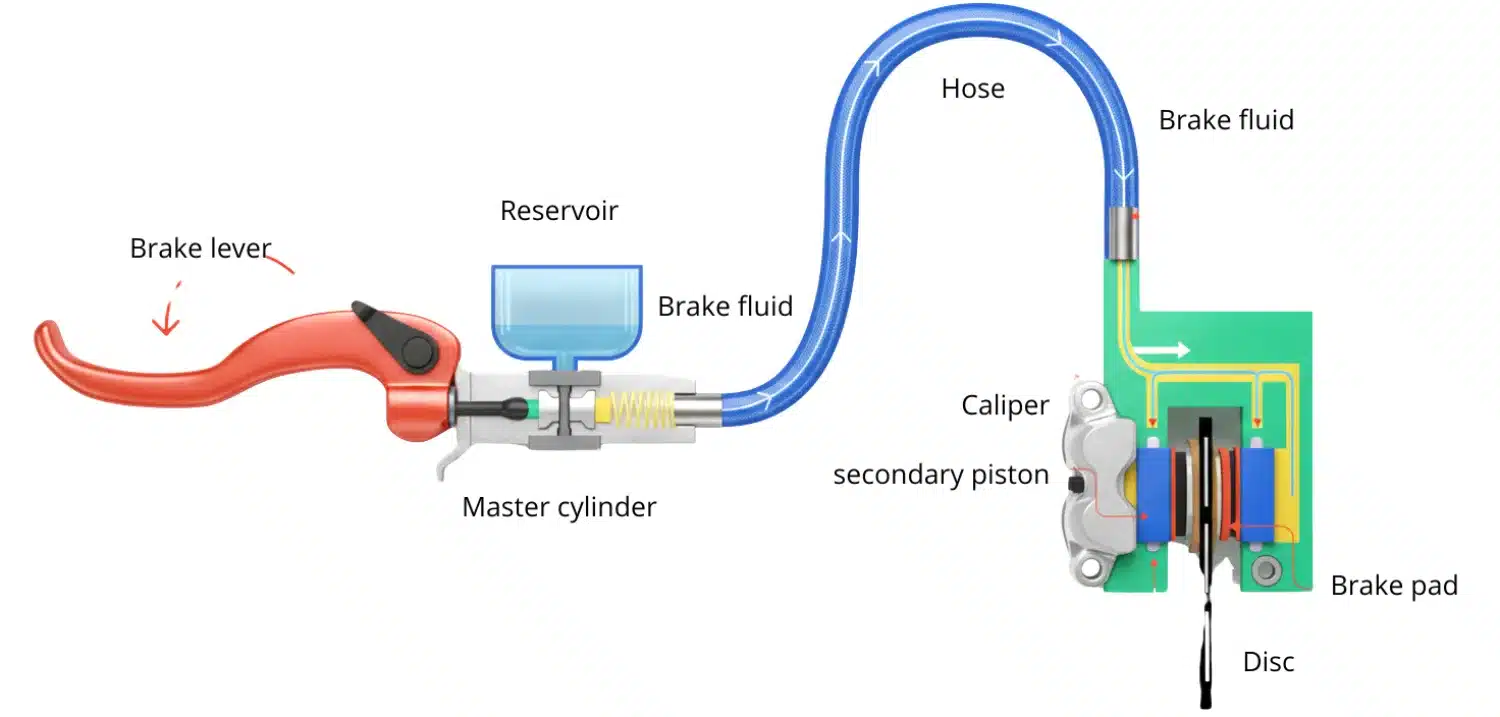
But first, here’s how the hydraulic brake system works. The brake lever activates a piston located in the brake caliper. This movement compresses the brake fluid contained in the external reservoir. The pressure is sent to the brake calipers via the hoses. The pads are pushed against the discs and release as soon as the pressure is released.
1. The master cylinder and lever control the pressure
The master cylinder is the first point of intervention in the braking system and the brain of the hydraulic system. It is directly connected to the brake lever.
When the lever is activated, the master cylinder piston pressurizes the fluid and sends it through the hoses to the calipers.
Points to watch
The lever must not have excessive play in order to fully activate the piston. Regularly inspect the master cylinder for leaks and keep the fluid between the marks. A low level often indicates worn pads. The lever must be firm to the touch. A spongy feel indicates the presence of air or degraded fluid, requiring immediate attention.
Possible improvements:
Make sure your master cylinder is as efficient as possible in relation to the calipers. Several diameters are available to send the fluid to the calipers with varying degrees of force, depending on the number of pistons. Sizes usually range from 13 to 19 mm.
2. The Hydraulic System: brake fluid.
Brake fluid: This is an incompressible hydraulic fluid that transmits pressure from the master cylinder to the caliper pistons. Its main characteristic is its high boiling point (heat resistance): it must remain liquid even when the brakes are under heavy use.
Points to Monitor
Brake fluid is hygroscopic, meaning it absorbs moisture, lowering its boiling point. When overheated, the water evaporates and creates bubbles. This is called vapor lock, a sudden and dangerous loss of braking power. Bleed and replace the fluid every two years, regardless of mileage.
Possible improvements:
You could change the quality of the fluid. DOT 3, 4, and 5.1 synthetic fluids are commonly used and are miscible with each other. For competition, “Racing” variants offer superior thermal resistance and low compressibility, but they should not be used for road use, even for sports riding. Motorcycles such as Harley-Davidsons often use DOT 5, a silicone-based fluid. Hydrophobic and durable, it does not deteriorate with moisture, but it must never be mixed with any other brake fluid.
3. The Hydraulic System: Hoses
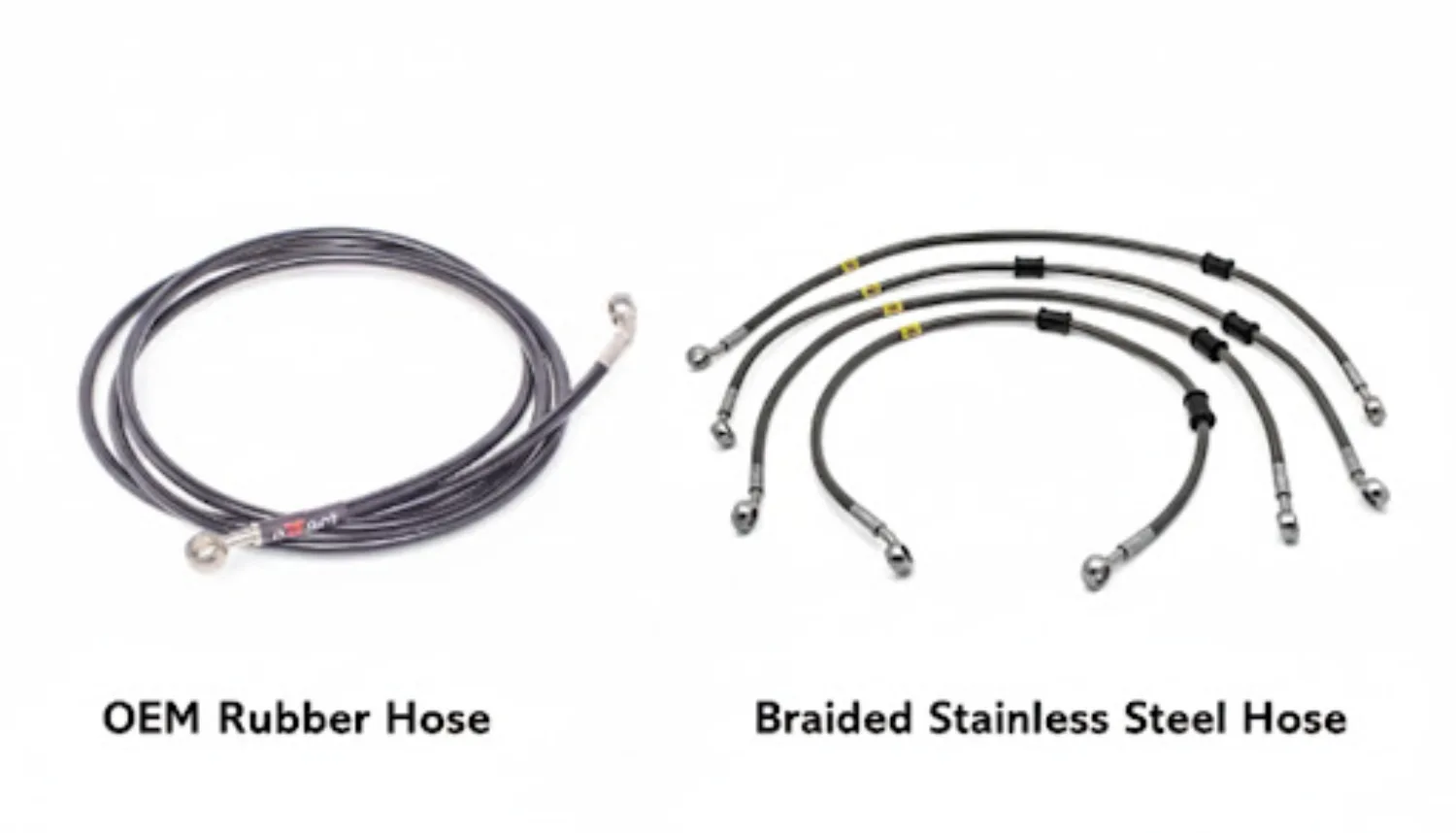
Brake hoses carry the fluid under pressure. Rubber models are often fitted to original vehicles. They age less well and expand in heat, making the lever spongy.
Braided aluminum models, such as those used in aviation, are more durable, with better rigidity and more efficient pressure transfer.
Possible improvements:
Changing a rubber hose for a braided model is the first action to take to improve braking (not counting the brake pads, which are a consumable item). The braided aluminium hose will not deform with heat, and it will carry the fluid more quickly to the caliper.
4. Piston calipers: To clamp the disc
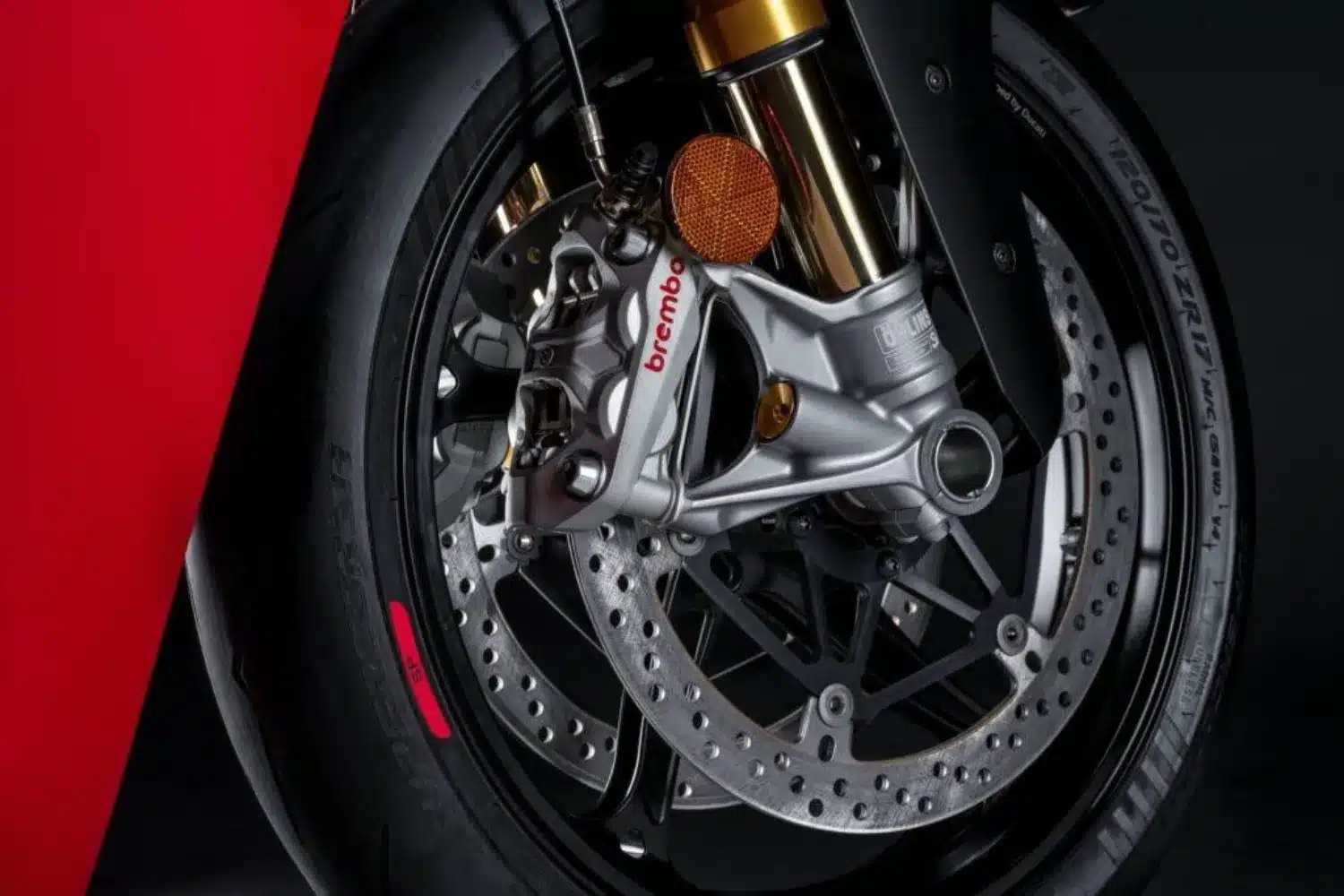
The brake caliper is the component that receives hydraulic pressure and generates the clamping force on the disc. It is mounted at the bottom of the fork and has one or more pistons. When the pressure of the brake fluid arrives, it pushes these pistons which, in turn, press the pads against the brake disc. The number and size of the pistons determine the power and distribution of the braking force.
Monitoring Points
Cleanliness and Corrosion: Calipers are exposed to dirt, salt and water. It is important to keep them clean. Corrosion can seize the pistons.
Seized Pistons: If one or more pistons remain stuck (seized), they no longer slide properly. This can cause uneven pad wear, excessive heating of the disc, reduced braking power or wheel lock.
Possible improvements:
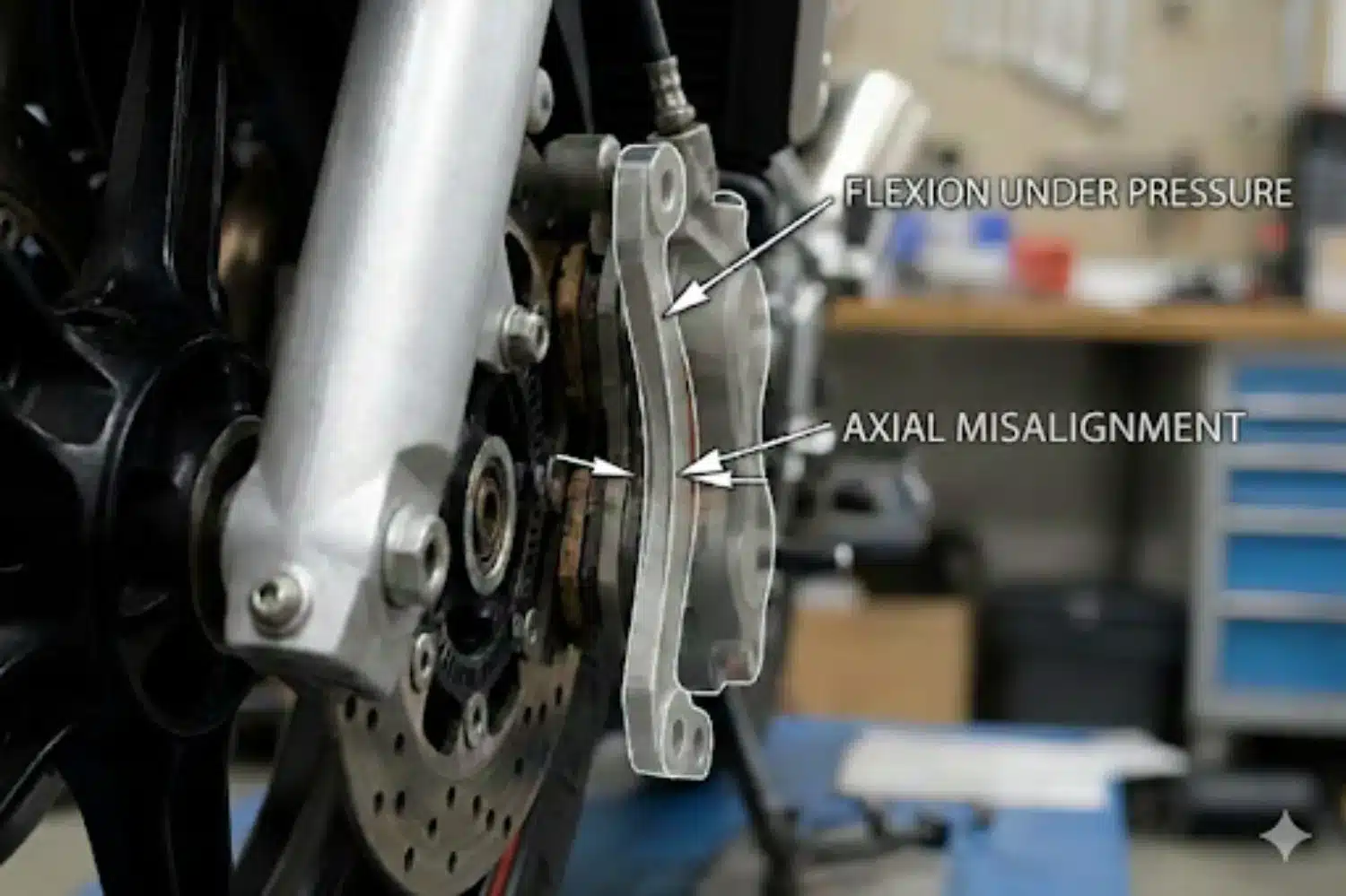
To optimize braking, you can increase the number of pistons to increase the contact surface. Replacing an axial caliper with a radial assembly also improves efficiency.
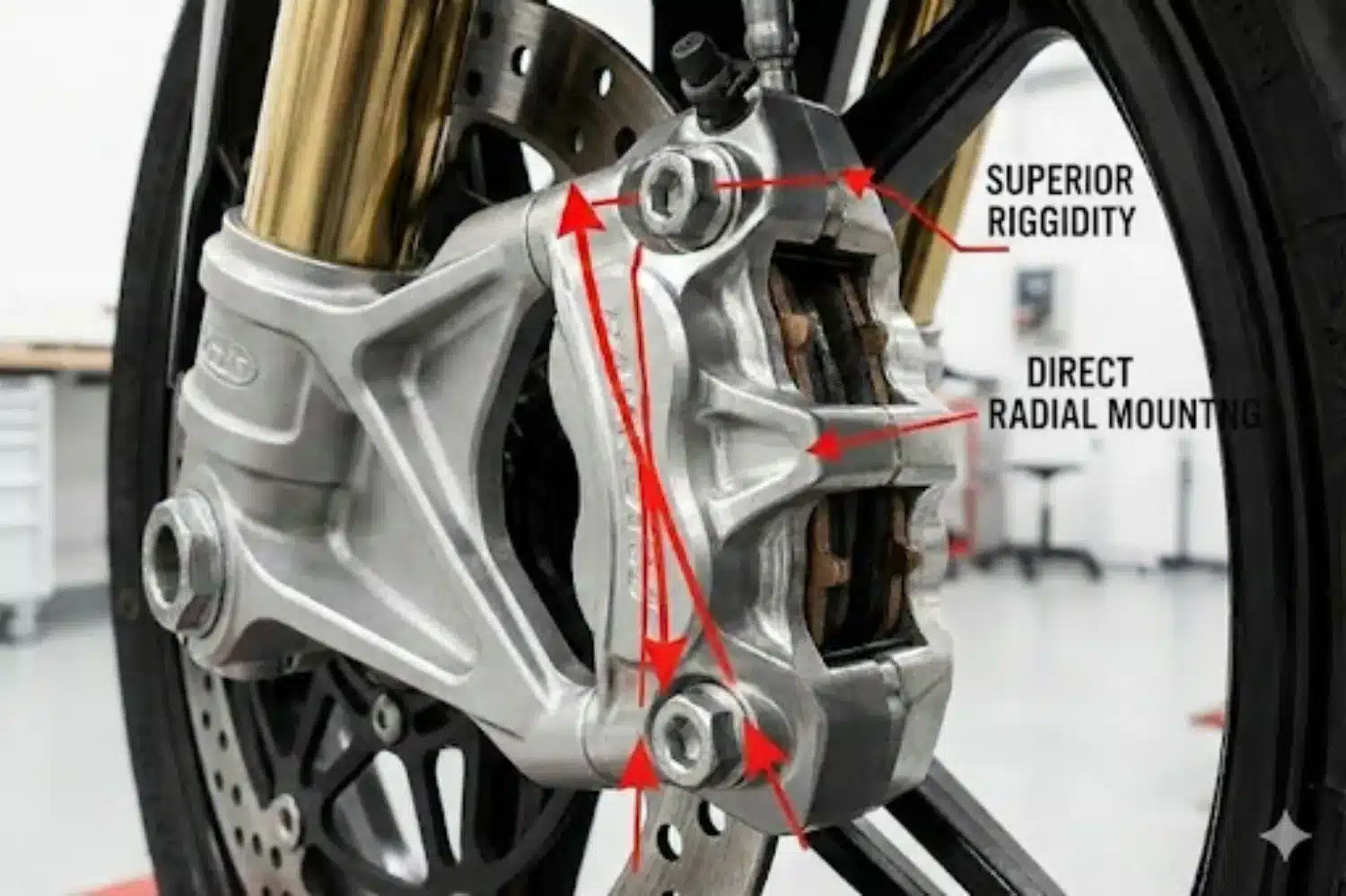
The axial caliper can deform, while the radial caliper remains rigid because it is parallel to the wheel axle. This configuration provides precision and power.
5. Brake discs
The pads bite into the discs until the motorcycle comes to a complete stop. The perforations or grooves on the discs (floating or fixed) serve to dissipate heat and evacuate water.
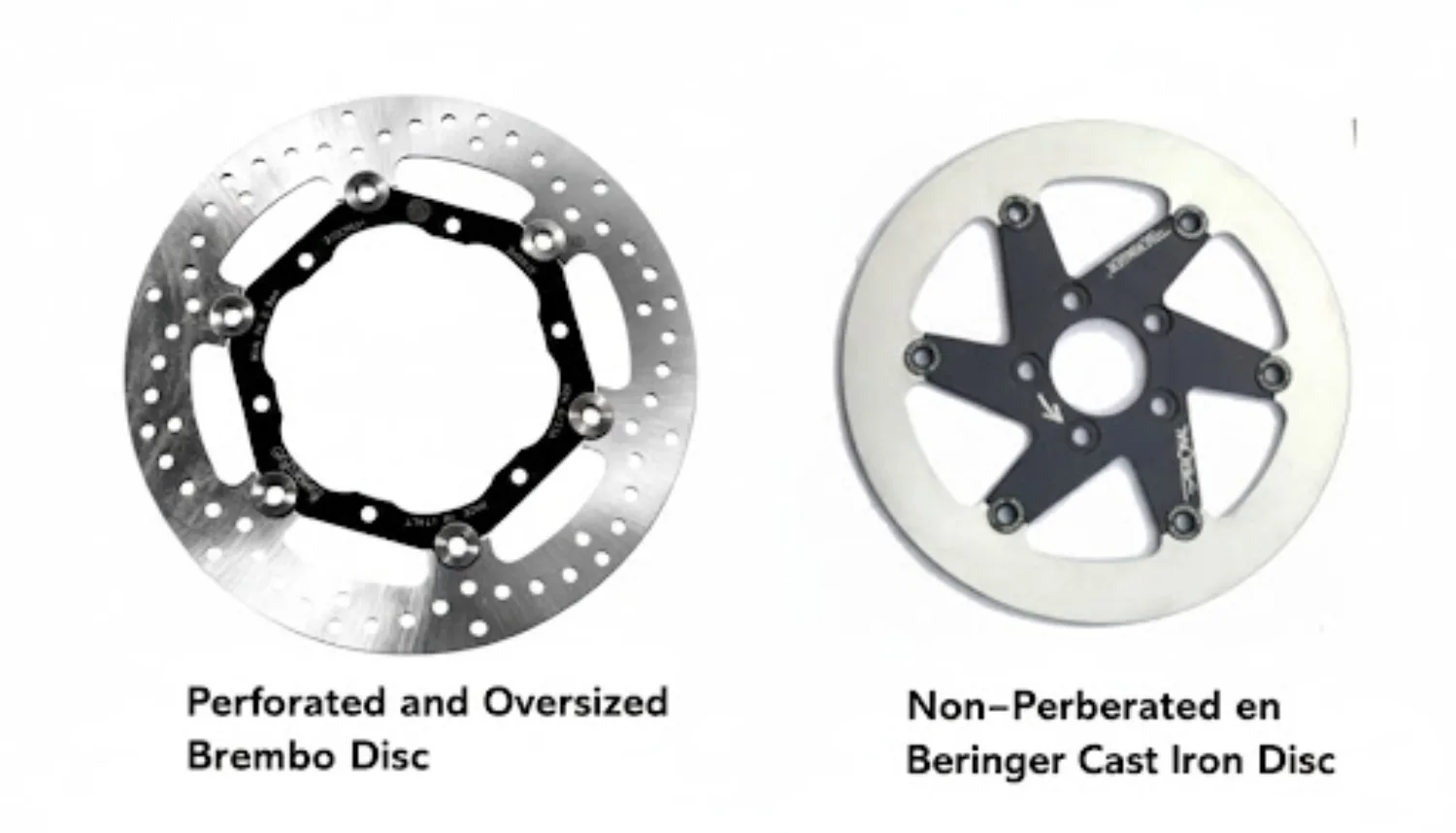
The Brembo brand favors oversized stainless steel and aluminum discs with perforations or grooves, which remove debris while accelerating cooling.
For its part, the Béringer brand mainly uses cast iron, which dissipates heat. This avoids perforations in the disc and oversizing of the disc. The brake pads are less stressed by the perforations. Each brand has its own arguments.
Monitor the thickness of the discs to prevent breakage; replace them as soon as the limit is reached. Overheating can warp the metal, causing vibrations or creating microcracks near the perforations. Finally, a blue or scratched surface should be considered a warning sign.
6. Brake pads: The science of friction
Brake pads consist of a metal backing covered with a friction material. Pushes by the pistons, they rub against the disc to slow down the motorcycle. Their material, whether organic, sintered, or Kevlar/carbon, determines their use.
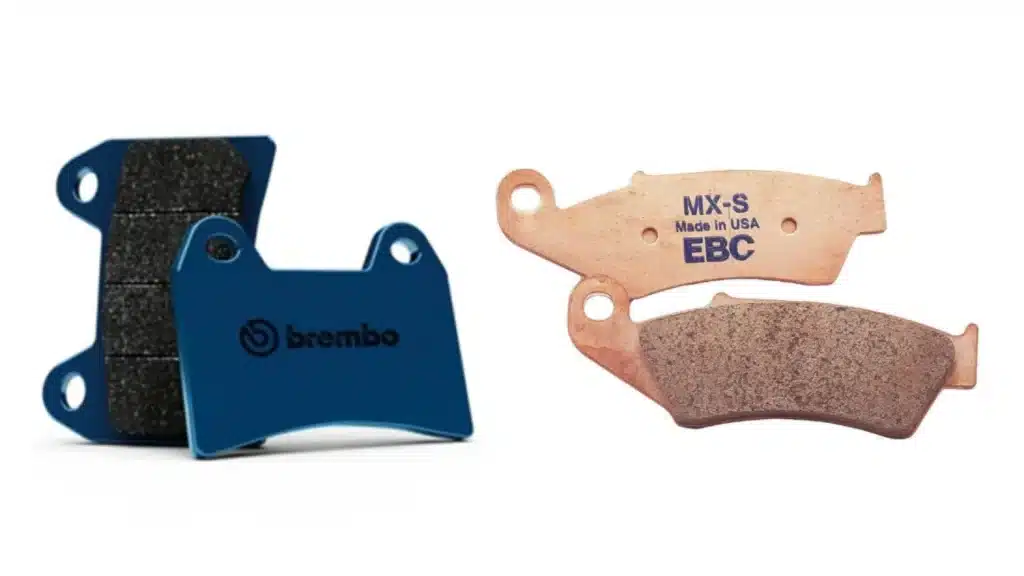
Organic models are the most economical and most commonly used for regular road use. They combine rubber with composite materials (carbon, glass, fiberglass, and Kevlar®), all bound together with a high-performance resin. They used to contain asbestos, which has been banned due to its carcinogenic risks.
Sintered metal pads are made from metal powder, which is more effective. Their high thermal resistance allows them to withstand temperatures of up to 600°C (compared to 400°C for organic pads), making them ideal for sports bikes and large motorcycles. On the other hand, the hardness of this material puts more strain on the brake disc, causing it to wear out more quickly.
Kevlar or carbon pads are for track use only: Designed for high performance, these pads require preheating. They are ineffective and potentially dangerous for road use because they do not reach the minimum heat required.
Points to watch out for
For thickness, maintain at least 2 mm of lining to avoid destroying the disc and losing braking power. Watch out for uneven wear, which is a sign of a defective piston, or vitrification due to overheating, which requires sanding or replacement. Finally, any metallic noise could be the result of direct contact between the support and the disc.
The brake system chain
Each of the six components of the brake system is essential and dependent on the others. A defect in a single part (old brake fluid, a seized piston, a pad that is too thin) can compromise the effectiveness of the entire system. As the saying goes, a chain is only as strong as its weakest link.