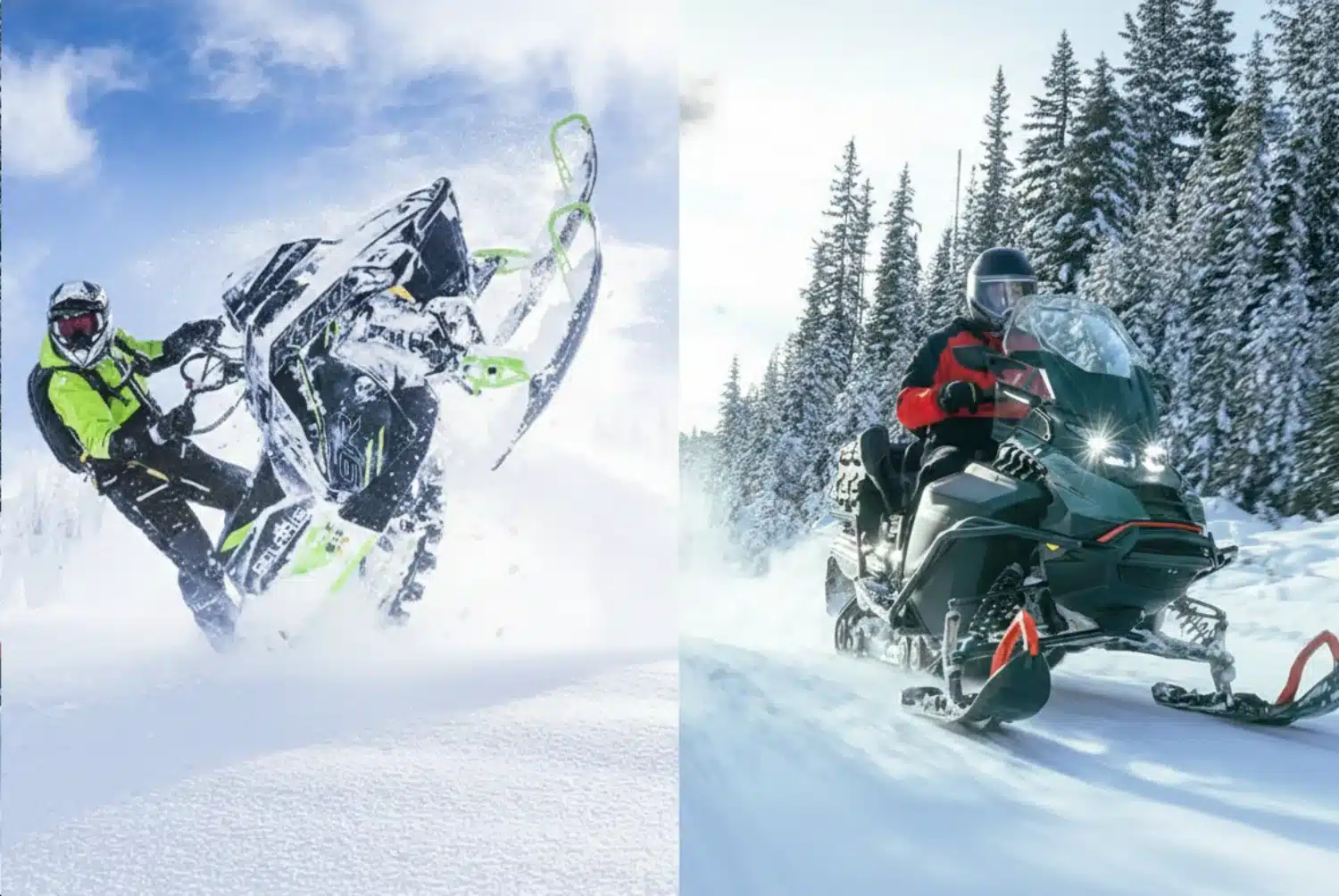
Historically, snowmobiles have been powered mainly by two-stroke engines, and from the beginning, Ski-Doo snowmobiles have been powered by Rotax engines of this type. For its part, the Japanese brand Yamaha has mainly opted for four-stroke engines.
The choice of engine is central to the winter experience, and the debate between the two technologies remains as heated as ever. Performance and power are at the heart of the choice. The needs are not the same on trails and off-trail. In this terrain, the power-to-weight ratio is paramount, as well as immediate power and lightness. This favors two-stroke engines. On the other hand, on the trails, four-stroke engines have begun to dethrone two-stroke engines thanks to their durability, torque, engine braking, and less aggressive sound.
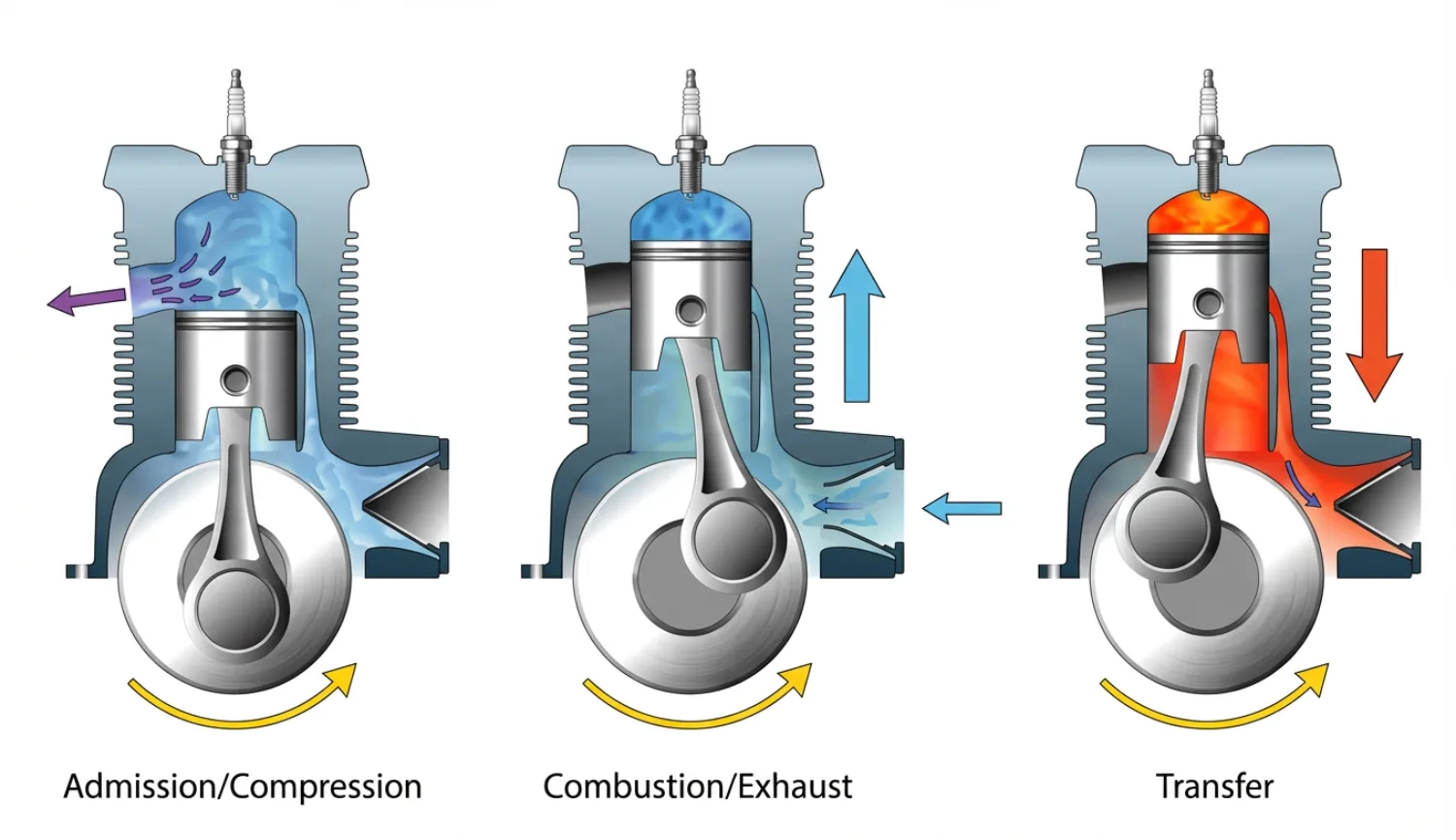
Injection in defense of two-stroke engines
Two-stroke engines have not always had a good image, as older generations remember them as engines that emitted a lot of smoke. The smell of frying would stick to clothes in the evening at the campsite. That was the era of carburetors, when the air/oil/gasoline mixture was not very precise. But there has been a major improvement with the arrival of electronic injectors, which have the advantage of distributing the exact mixture of air, oil, and gasoline. There is less unburned gas. Today, these engines meet the strict standards of the California EPA, which has not yet reached the ears of certain Quebec authorities who do not allow them in Mont-Tremblant Park, leaving this privilege to snowmobiles equipped with four-stroke engines.
There are many advantages to two-stroke engines. The lightness and responsiveness of these engines radically transform the riding experience, especially off-trail where maneuverability is an asset. These engines are distinguished by their instant response to acceleration, providing thrills with every ride.
The excellent power-to-weight ratio is achieved through simpler, lighter mechanics, as there are no valves or camshafts. The snowmobile is more maneuverable, more agile, and easier to get out of powder snow.
It also has many loyal fans on the trails, as it is lively and maneuverable, with immediate and exciting acceleration. Mechanical maintenance is more accessible thanks to a simplified design, although the lifespan of internal components such as pistons often requires a major overhaul after a few seasons.
Which engines?
In recent years, the 850 cc displacement has become the standard for two-stroke performance in off-trail and deep powder conditions. The 850 cc segment is dominated by several cutting-edge technologies that compete among brands.
At Ski-Doo, the 850 E-TEC engine is the benchmark in this field. The 180-horsepower Rotax 850 E-TEC Turbo R features direct electronic fuel injection and a water injection system, which not only provides instant throttle response but also optimized oil and fuel management.
At Polaris, the answer to the 850 E-TEC comes mainly in the form of the 850 Patriot engines (approximately 165 hp) and, more recently, the 850 Patriot Boost (turbocharged version) with power approaching 180 hp. The Patriot is designed to be powerful but less complex than the E-TEC system, sometimes making certain mechanical interventions easier.
Arctic Cat finally responded to its competitors by launching its all-new 858 C-TEC2 engine with an estimated power output of close to 180 hp. It was designed to integrate seamlessly with the new Catalyst chassis and lower the center of gravity.
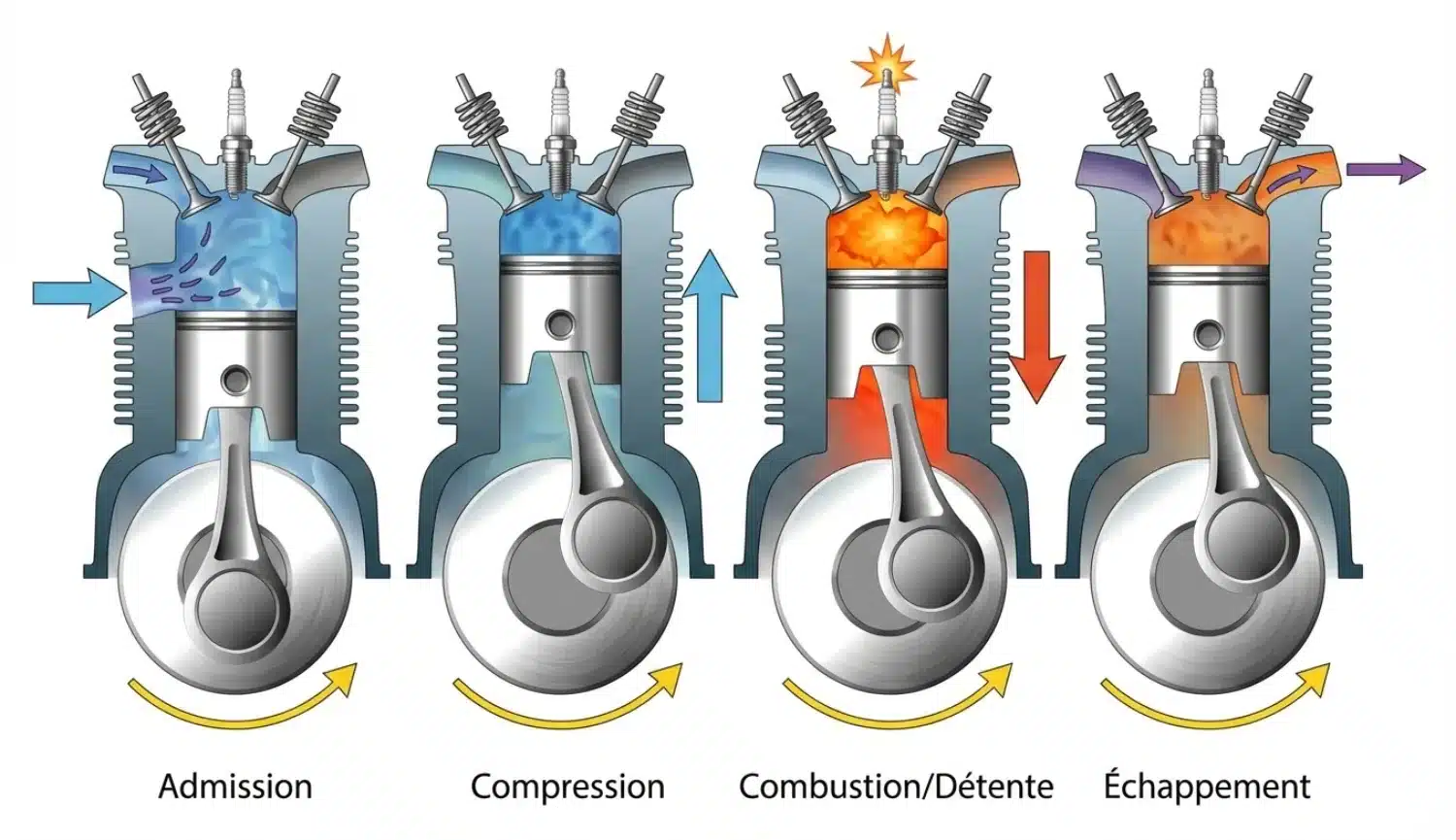
The quietly powerful four-stroke engine
Choosing a four-stroke engine represents an initial investment, but it pays off in terms of durability and riding comfort.
This technology does not require mixing lubricant with fuel and eliminates the smell of burnt oil. Fuel consumption is often lower, which improves range, a useful feature on long journeys or in remote areas.
Engine torque is more noticeable and can be felt both in more linear acceleration and when slowing down in curves. The engine brake replaces the use of the brake lever when driving smoothly and steadily. The left hand is used much less.
Acceleration is less responsive than with the two-stroke version, but it is still very satisfactory thanks to the torque on certain two- or three-cylinder versions, not to mention the turbocharged models. The lower noise level is less noticeable, as long as the exhausts are not modified.
Although these engines weigh more, this extra weight increases stability and comfort over bumps thanks to the good positioning of the engine block in the chassis. Finally, mechanical durability is superior. Some four-stroke engines exceed 20,000 or even 30,000 kilometers without major intervention on the internal components.
Overview of 4-stroke engines
Among turbo engines, the power is identical, even slightly higher than two-stroke engines with 180 and 200 horsepower, but it is not distributed in the same way. While the two-stroke turbo provides aggressive and immediate acceleration, the four-stroke model accelerates more gradually, with torque power and a more linear rise in revs.
The Rotax 900 ACE Turbo R from Ski-Doo boasts 180 horsepower. It is equipped with an intelligent throttle control (iTC) system that offers three driving modes.
Yamaha and Arctic Cat share a 998 Turbo engine, known as Genesis at Yamaha and Thundercat at Arctic Cat. Its top speed is unmentionable, and it can be modified for even more performance.
Polaris’ ProStar S4 Turbo offers massive torque and a very responsive feel for a 1000cc twin-cylinder, four-valve engine.
In naturally aspirated, non-turbo engines, Ski-Doo has had great success with the Rotax 900 ACE 95 hp, renowned for its smoothness and economy.
Polaris now offers the 1000cc twin-cylinder ProStar S4 engine. It replaces the old entry-level two-stroke engines with a cleaner and more durable solution.
The Arctic Cat 7000-Series (C-TEC4) is actually a 1049 cc 3-cylinder 4-stroke engine, shared with Yamaha, developing around 135 hp. It is renowned for its reliability and power. It is found on the Yamaha TR-1 model, which has unfortunately been discontinued.
Fuel consumption and maintenance
In terms of fuel consumption and maintenance, the two engines are opposed in terms of their type of use. The two-stroke engine requires rigorous monitoring and a specific budget for injection oil, which is consumed directly during combustion. Although injection reduces this appetite, the rider must anticipate recurring oil costs and expect more fluctuating fuel consumption, especially when driving aggressively.
On the other hand, mechanical maintenance is more accessible thanks to a simplified design. The pistons must be changed regularly, but the cost of repair is lower.
In contrast, the performance of a four-stroke snowmobile translates into more economical management in the long term. The oil remains in a closed crankcase, requiring only an annual oil change, and fuel consumption remains stable and generally lower than that of a large two-stroke engine.
Although routine maintenance is more technical due to the complexity of the engine block (valves, timing, filters), overall longevity is significantly higher, frequently exceeding 20,000 kilometers without major repairs. However, engine failure is very costly and must be avoided through regular maintenance.
The four-stroke engine is therefore preferred for its reliability and ease of operation on long trips, while the two-stroke remains the choice for pure performance despite more frequent maintenance requirements.
There is no wrong choice; it is up to each individual to choose the pleasure they seek from their snowmobile.