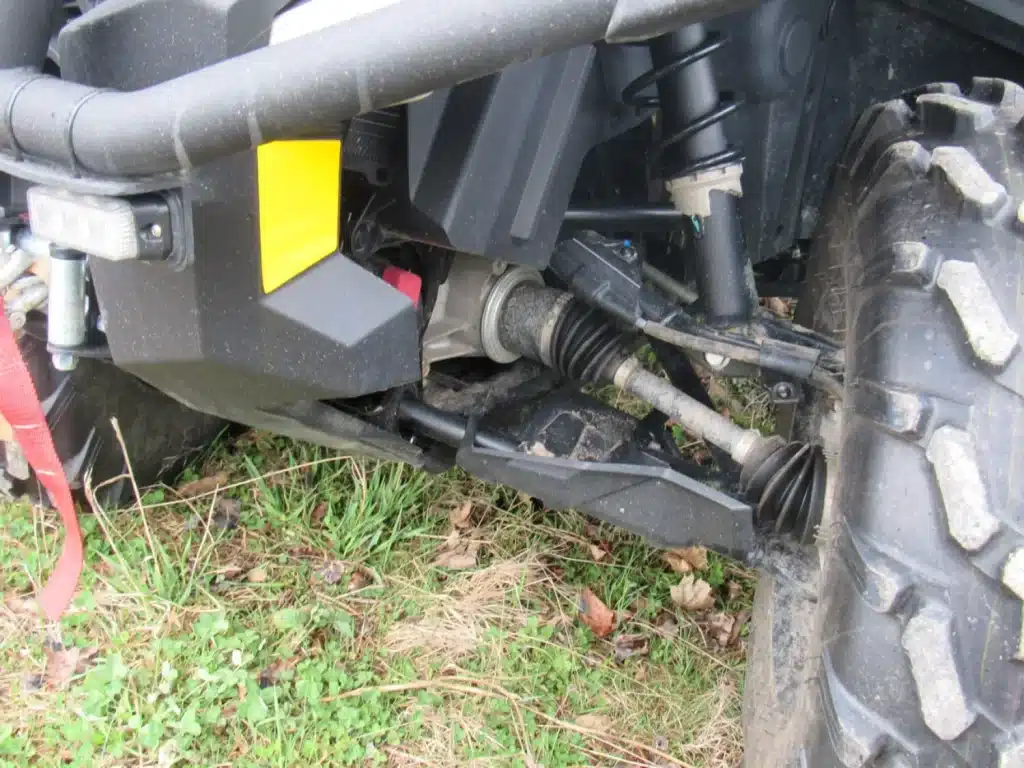
Since the early 2000s, the Visco-Lok system has been one of the technical hallmarks of Bombardier ATVs, and later Can-Am ATVs. This system was innovative in combining the benefits of a front differential that remained open under normal conditions with automatic locking when the going got tough, without any input from the rider. The internal Visco-Lok mechanism detects differences in rotational speed between the front wheels and progressively increases their coupling when one of them loses traction.
This technology has evolved through three main stages: the original Visco-Lok, Visco-Lok QE (Quick Engagement) and, since 2021, Visco-4Lok. While all three systems share the same basic idea, their ability to respond to wheelspin and, above all, to lock the front differential differs considerably. Let’s take a look at the differences between the three systems.
The Original Visco-Lok: Fully Automatic Self-Locking
Visco-Lok first appeared on Bombardier ATVs in 2004 and quickly became a distinctive Outlander feature. Its purpose is to combine the handling of a conventional front differential with self-locking capability that requires no input from the rider.
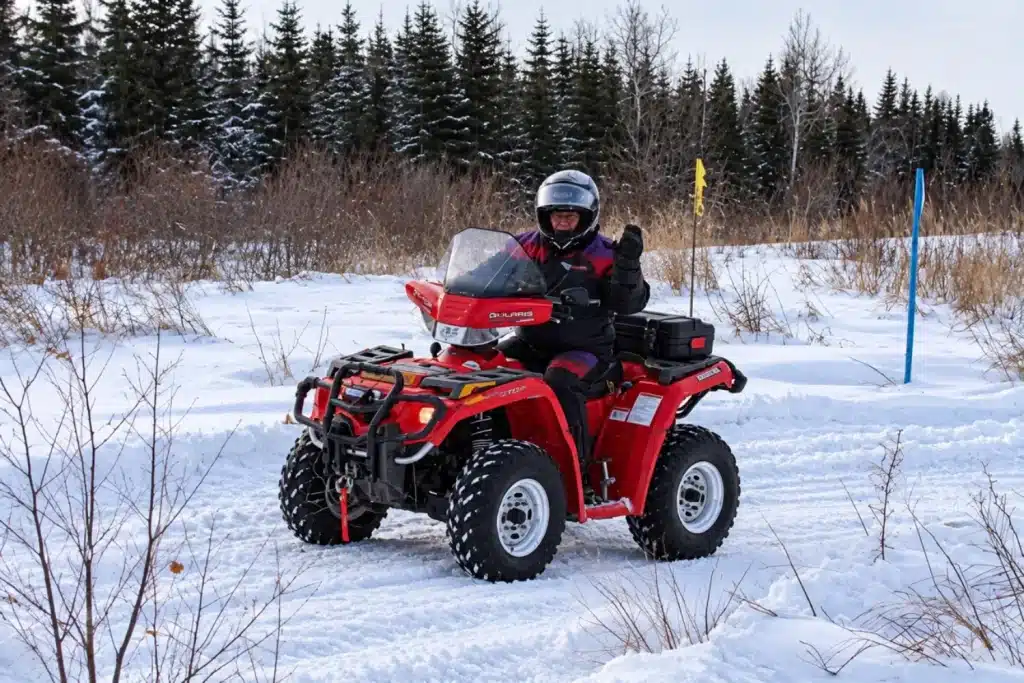
Under normal riding conditions, the differential allows the two front wheels to turn at different speeds. This freedom is particularly important in corners, since the outside wheel must travel farther than the inside wheel.
When one wheel loses traction and starts turning faster than the other, this speed difference progressively activates the Visco-Lok mechanism. It increases the coupling between the two differential outputs to transfer more torque to the wheel with better traction.
Everything happens mechanically and automatically. The rider therefore does not need to operate a differential-lock lever or button. All that is required is to select four-wheel drive.
This simplicity is one of Visco-Lok’s main advantages. Under normal riding conditions, the differential allows the front wheels to turn relatively freely at different speeds, avoiding the heavy steering and tendency to push straight ahead that are typical of a fully locked differential.
The original system does have a weakness, however: there must be a speed difference between the front wheels before it responds. One wheel must therefore start spinning before the mechanism transfers enough torque to the other wheel to lock the differential. On a normal trail ride, this delay is rarely a problem, but it becomes more noticeable when crawling over obstacles, riding through rocks or when one wheel is carrying very little weight. Some riders criticized this shortcoming because, by the time the differential was firmly locked, the ATV was already bogged down.
Visco-Lok QE: Reducing the Response Delay
To address this problem, Can-Am significantly improved its system with the introduction of Visco-Lok QE, short for Quick Engagement, around the 2010 model year.
The general principle remains the same as that of the original Visco-Lok. It is still not a differential that the rider can lock manually. The system mechanically detects a speed difference between the front wheels and automatically increases their coupling when one wheel starts spinning.
The major improvement is its engagement speed. Visco-Lok QE requires a much smaller speed difference before responding. Initial wheelspin is therefore reduced, and torque is transferred to the wheel with traction much more quickly.
This evolution largely corrects the main shortcoming of the first system while retaining its advantages: automatic operation, progressive response and little effect on steering under normal conditions.
Visco-Lok QE would go on to enjoy a particularly long run at Can-Am. Introduced around 2010, it did not disappear with the arrival of Visco-4Lok. Can-Am continues to use it on several recent ATVs. It therefore remains a current solution for models where a full manual differential lock is not considered necessary.
Visco-4Lok: Adding a True Mechanical Lock
For the 2021 model year, Can-Am took another step forward with Visco-4Lok, initially introduced on specialized versions such as the Outlander X mr and Renegade X mr before becoming available on more models.
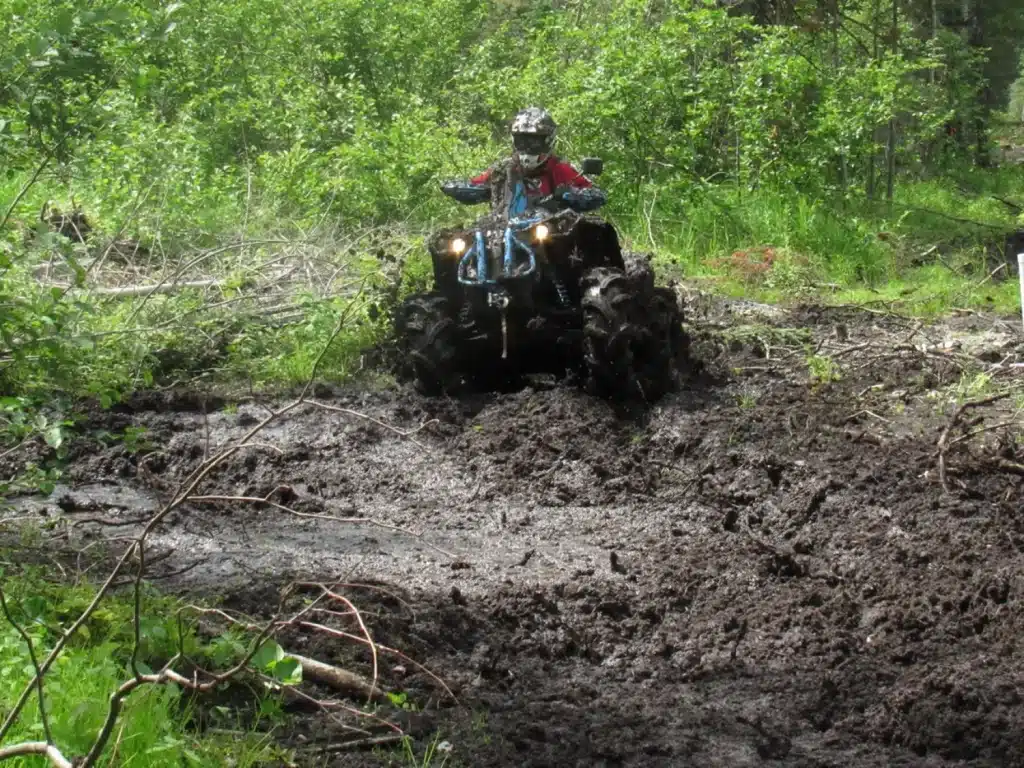
Finally, Visco-4Lok, introduced for 2021, lets the rider lock the differential on demand with a handlebar button, or simply let it work on its own on the trail. This will be especially useful for X mr models exploring the deepest mud holes, or for winter adventurers plowing through snowdrifts.
With this evolution, Can-Am retained the principle of the Visco-Lok family’s limited-slip front differential, but added a previously unavailable feature: the rider can mechanically lock the front differential on demand.
Under normal use in 4WD mode, Visco-4Lok behaves like a limited-slip differential. Torque can vary between the two front wheels according to traction conditions, while still allowing them to turn at different speeds. This preserves the ATV’s handling and avoids the drawbacks of a constantly locked differential. Can-Am also describes Visco-4Lok as an evolution of its Visco-Lok limited-slip system.
When the terrain becomes more difficult, the rider can select 4WD LOCK mode. The system then fully locks the front differential mechanically. Once this function is engaged, power is transmitted directly to the wheels from the main gear without having to wait for a wheel to spin to obtain maximum traction. The system becomes particularly useful in deep mud, rocks, very challenging climbs or when a front wheel is almost completely off the ground.
Can-Am has also integrated Visco-4Lok operation with DPS power steering, the ECU and the powertrain to limit the effects of locking on handling.
Three Generations of Visco-Lok Addressing the Same Problem
The evolution of these three systems illustrates the strategy Can-Am has followed for more than two decades: getting the most out of the front differential without rider input. This technology, which was rather slow to respond in its early days, has become more refined over time, notably with Visco-Lok QE around 2010.
Finally, Visco-4Lok, introduced for 2021, lets the rider lock the differential on demand with a handlebar button, or simply let it work on its own on the trail. This will be especially useful for X mr models exploring the deepest mud holes, or for winter adventurers plowing through snowdrifts.